Image
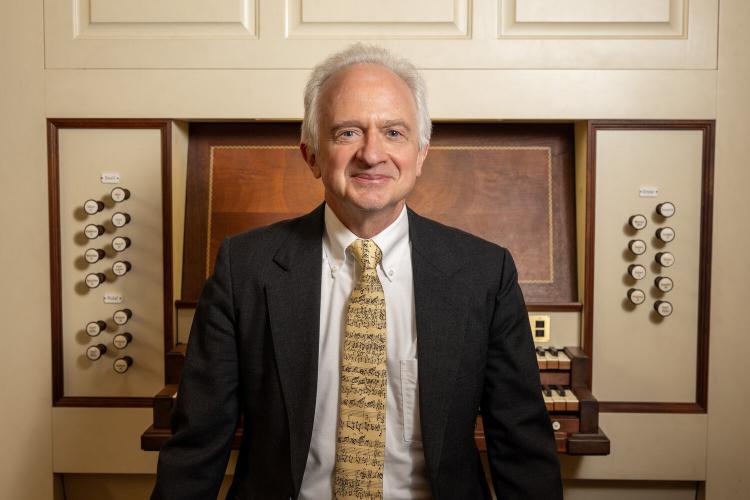
Paul T. Barte Ph.D. has been a fixture of the music faculty in the Chaddock + Morrow College of Fine Arts School of Music since 1997, teaching organ and harpsichord, organ literature and pedagogy and music history classes, earning a 2005 Distinguished Teaching Award, while also serving as the University Organist.
As Barte plans to retire this December, he reflects on his time at OHIO coming to a close and his plans for the future.
A Minnesota native, Barte started studying piano as a young kid.
“People who study organ almost invariably start out as pianists and then migrate to the organ,” Barte explained. “At a junior high age, I became a Bach fanatic. Bach is very central to the repertoire of the organ, and I would say specifically because of my interest in Bach that I ultimately pursued organ through my academic studies and then professionally, as well.”
The organ is, itself, a unique instrument because of its often-large size and space requirements. Organs can vary dramatically in terms of size, strengths and weaknesses, just in so many way, according to Barte.
Performers don’t travel with their organs; they travel to where the organ is to play it. This has given Barte the opportunity to play many different instruments over his career, and he has a few favorites.
The most influential organ on his playing according to Barte is located at the House of Hope Presbyterian Church in St. Paul, Minnesota, where he grew up.
“That organ was installed in 1979. I graduated from high school in ’78 and did my undergrad degree at the University of Minnesota,” he said. “That church had a concert series that was extraordinary. They had some of the most famous organists from around the world performing there. I had the chance to hear not only this amazing organ, which is among the best I've ever been privileged to play, but got to hear playing on it some of the finest organists in the world. That was a very impactful thing for me as a young man, just having the opportunity to hear that organ and play that organ and just experience so much there.”
Organs are not known for being understated, something that Barte is drawn to, both as a player and opera fan.
“Organists tend to be a little bit megalomaniac. We love power. The power of the instrument is certainly one of its appeals. As a result, it's not too unusual that organists will tend to have particularly strong feelings for enormous examples of the organ-building art. For me, the largest organ in the world which I have ever played is the organ at the Mormon Tabernacle in Salt Lake City, Utah. It's one of the largest in the world. Performances which I've done there certainly have been extraordinarily fun. To be in this enormous building and then playing this incredibly powerful instrument, it's very difficult to describe the visceral effect of that organ.”
But Barte’s career at OHIO can’t be separated from his most played organ over the years.
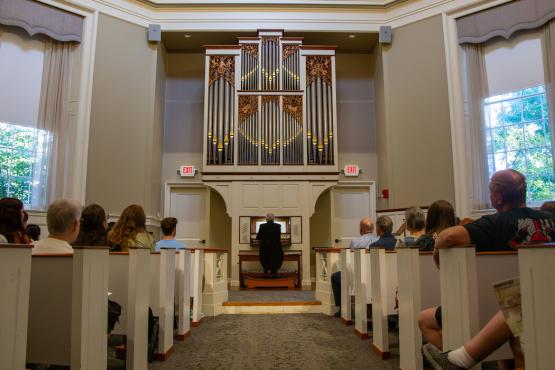
“On the opposite end of the spectrum is Galbreath Chapel,” Barte said. “It's very small. It's roughly one-tenth the size of that organ at the Mormon Tabernacle. But the organ at Galbreath Chapel was installed the year that I joined the faculty, so it's been my baby from day one. I have spent tens of thousands of hours playing, practicing, performing on that organ, and of course teaching my students using that organ. So, I have a very, very huge spot in my heart for that instrument, which is small, but it's an extremely high-quality instrument. To have an instrument that is that excellent in terms of its construction and just the sound palette that it has, has been certainly a joy of my time here at Ohio University.”
And it’s that time behind the keyboard, working with his students, that has clearly left an indelible impression upon their education and that magical moments of educational mentorship have taken place. When thinking of his final semester, Barte is thoughtful and grateful for his time with his students.
“Well, it will probably get more emotional as the semester continues. And as I teach the music history classes for the last time, I've already just been thinking about the last week that I'm teaching is going to be hard. I'm going to have a hard time keeping my emotions in check when the end draws nearer.”
Alumni of Barte also have great respect and appreciation for what he’s brought to their lives.
SeungKeun Oh (M.M ‘24) recalls that he met Barte in music history class and that Barte was his private organ professor.
“His role in my education was so huge because he taught not only a lot of history but…supported my education, taught me good pedaling skills, showed me how the organ is built inside, and even gave me an organ pipe for fun. It’s in my house still! I’m so lucky to have worked with Dr. Barte, he was a wonderful professor,” Oh said.
Taae Hamid (M.M. ’24) also credits Barte for his technical prowess and assistance finding a job after graduation.
“If it weren't for Dr. Barte, I wouldn’t have my current musical director job,” Hamid said. “I want to thank him for helping me transition from being primarily a pianist to a good organist. Organ has given me so many more opportunities that I could have even dreamed of and it’s all thanks to Dr. Barte helping me to become a great organist like him.”
Matthew Talbert, director of the School of Music and associate professor of Music Education, agrees that Barte’s mark his students education and future careers have been a gift for students and colleagues alike.
“Dr. Barte’s teaching in music history and organ has had a remarkable influence on the musical and intellectual growth of countless students at Ohio University’s School of Music,” Talbert said. “His knowledge, guidance, and musicianship have helped our students grow as thoughtful performers and scholars. His dedication and commitment have left a lasting imprint on the School of Music, and we are deeply grateful for the impact he has made on our community. Our students have been fortunate to learn from Dr. Barte, and our faculty have been just as fortunate to have him as a colleague.”
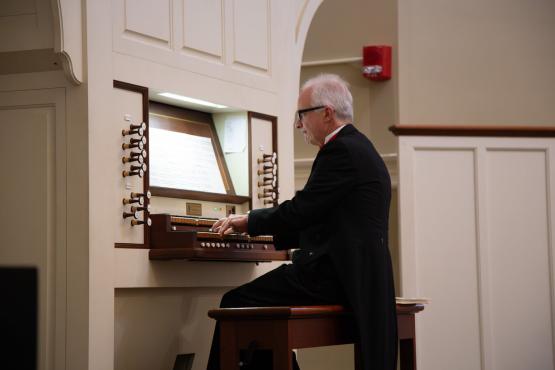
In addition to his influence on the student and staff community as OHIO’s organist, Barte also was pivotal in helping to bring live streams of The Met Opera to the Athena Cinema. A huge fan of opera, Barte has regularly used his summer breaks to travel the world to experience the very best professional opera performances. This has enriched his students’ classroom experience greatly and built a love of opera amongst many alumni he mentored.
In terms of his plans for retirement, Barte points to two immediate goals.
“Read. I have around my house, probably 200 books that I've bought and not yet read. And, again, going to operas. I do these months long trips where I'm going to opera performances frequently…a lot of planning has to go into preparation for that kind of a trip on my own. I'm not signing up for an opera tour or something like that. So, to plan what performances I want to go see and to connect the dots in terms of travel and where I'm going to stay, all of that travel planning is something that I end up spending, well, a surprising amount of time on.”
When questioned if he has plans to continue performing on the organ, Barte is happy to consider the possibilities of “still playing
for my church… but I don't know that I will do concerts anymore. Perhaps not. And I'm okay with that. I'm ready to let that chapter of my life fade away. I just did a faculty recital a couple of weeks ago now, and I called that recital Swan Song, which is a term that basically is identifying it as my concert giving grand finale.”