OHIO's Archives invite students to get hands-on with history
The Mahn Center for Archives and Special Collections is working to break down barriers, inviting all students to experience history through hands-on discovery.
Henry Gorsuch, BSJ '26 | Photos by Emma Stevenson, BS '27 | February 24, 2026
Share:
On the fifth floor of Alden Library lies a collection that defies stereotypes. It’s not a dusty, silent room where history is kept behind glass. It is a vibrant hub of discovery, holding everything from 4,000-year-old cuneiform tablets to personal photos of Mister Rogers. This is the Mahn Center for Archives and Special Collections, and its primary mission is simple: to be one of the most accessible and welcoming places on campus.
“We really want people to feel welcome,” says Miriam Nelson, Director of Archives and Special Collections, Preservation and Digital Initiatives. “These collections might sometimes have a reputation of being kind of stuffy or maybe a little bit elitist, and we’re trying to work against that in a lot of different ways. They’re here for everybody.”
That open invitation is the driving force behind a multi-faceted department dedicated to preserving history and making it an active part of the student experience at OHIO.
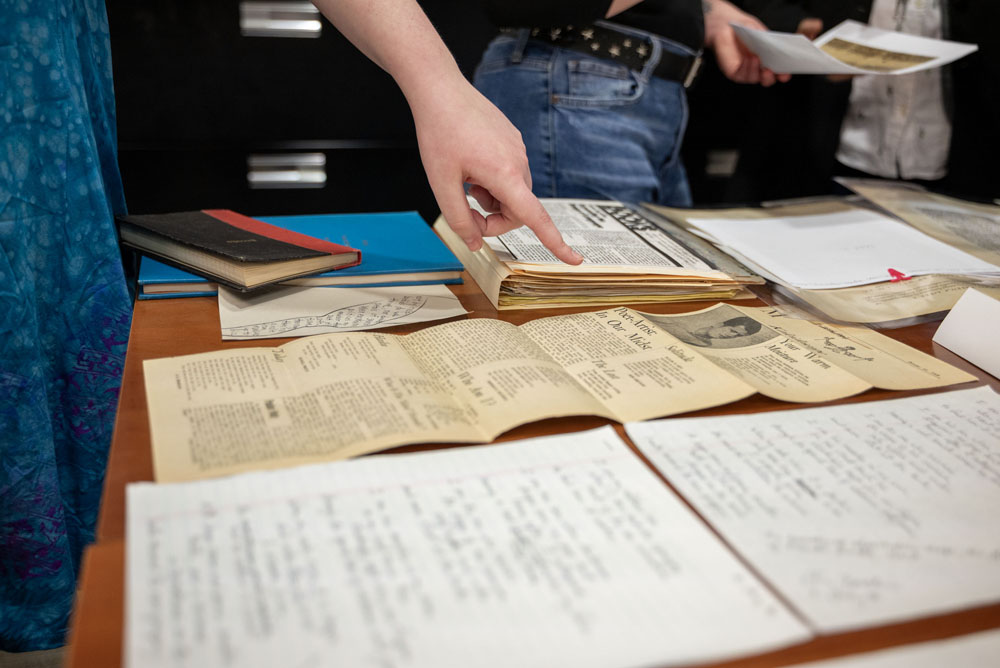
The archives offer students hands-on opportunities to explore historical documents up close.
A library within a library
For many students, “the archives” can sound like a single, monolithic entity, but it’s actually a dynamic collaboration between different collecting areas. As University Archivist and Records Manager, Bill Kimok is responsible for what he calls “the life history and culture of Ohio University.” His work is to preserve the university’s own story.
“It’s ensuring that documents created by the university and the people who make up the university are preserved in order to tell that story of the university’s history,” Nelson explains. This includes everything from official Board of Trustees minutes to student yearbooks and the rich history of campus life.
Meanwhile, Dr. Miriam Intrator, Head of Archives & Special Collections and Rare Book Librarian, oversees collections with a more global scope. These include rare books, historic manuscripts, the documentary photography archive, and artist books. One of her key missions is to fill in the gaps of history.
“That has to do with the history of whose stories and whose voices were considered valuable and worthy of putting into an archive or a special collection,” Intrator says. “And that understanding has really changed and expanded over time.”
This hands-on approach is the department’s signature philosophy.
“We insist that students do a hands-on experience with us,” says Kimok. “In the archives, sometimes they call it a petting zoo type of atmosphere… you don't have to experience our archives behind like two plates of glass with your hands behind your back.”
“You’re gonna hurt our feelings if you don’t pick stuff up and move it around and take a look at it,” he jokes.
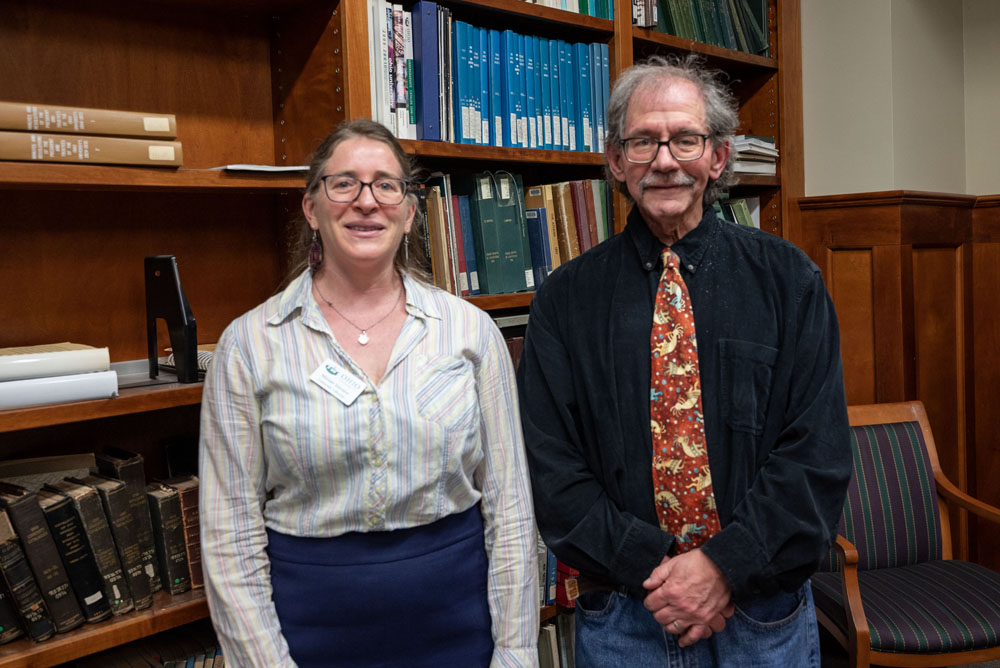
Head of Archives & Special Collections Dr. Miriam Intrator and University Archivist Bill Kimok at the Founders' Day Student Showcase.
Reading between the lines
This welcoming atmosphere empowers students to become historical detectives. Student interns Aidan Cox and Hester Lambright experienced this firsthand while working on a workshop with visiting historian Dr. Alexandra Finley. There, they learned how to go beyond the surface of a document using methods like “reading against the grain” (looking past stated facts to find deeper meanings) and “looking for silences” (identifying who or what is missing from the record to uncover lost stories).
The concepts were a revelation, transforming what might seem like dry material into a compelling story.
“…Seeing a financial ledger originally when you're looking at it, it isn't the most interesting story,” Cox says. “So I guess it just really helps spark your imagination and your critical thinking skills to think of close reading in that way versus just reading through the ledger and seeing what it means on the surface.”
For Lambright, these methods reinforced the researcher’s duty to uncover what history has buried. “She really drove the point home,” Lambright says. “You don't want to just keep telling the same story. You want to go into history. You want to find a story that is underrepresented. You want to bring it to light, and it just will open a whole world for new research.”
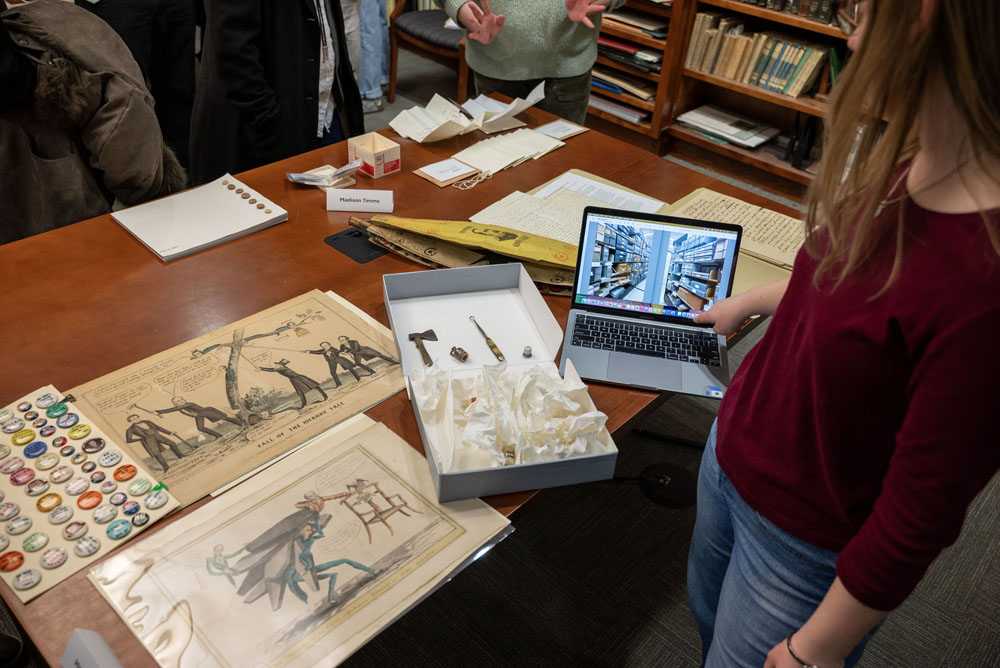
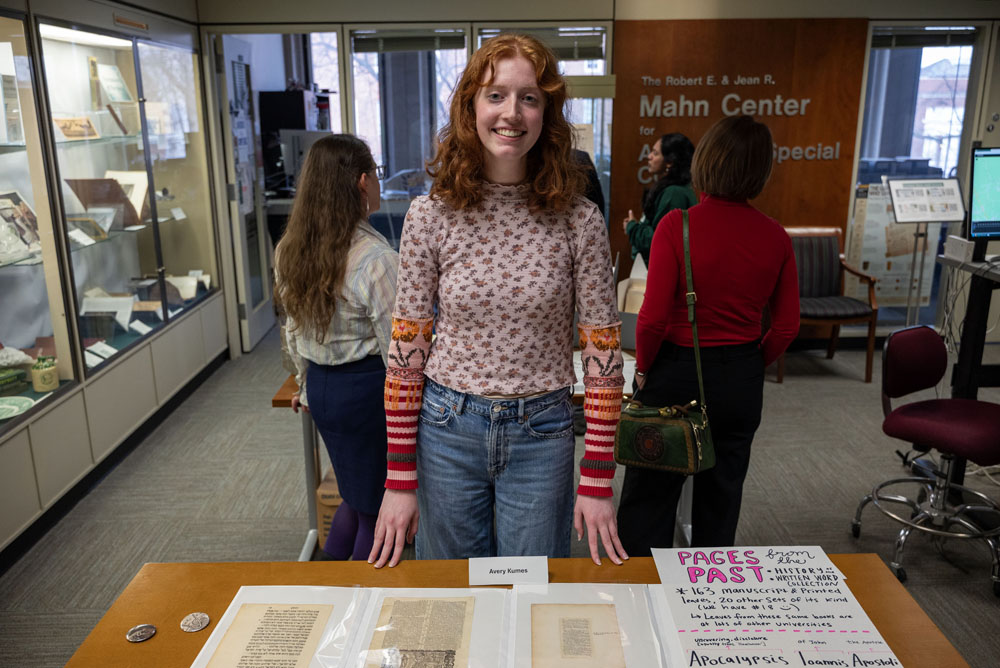
Attendees examine primary sources on display during the Founders' Day Student Showcase.
During the workshop, Cox saw the end result of this deep-dive research in Dr. Finley's work. It showed how fragmented records could be pieced together to tell a novelistic narrative, breathing life into historical figures.
“She kind of introduces them in a way that almost reads like fiction,” Cox says. “She walks through what their daily life might have been like or who their close relations were. And she could get all of that from the ledgers.”
For both students, the experience demystified the archives. They hope other students will take the leap and see what they can discover for themselves.
“I know people can feel intimidated by things like this, but this is a resource for students and people beyond students,” Lambright advises. “There is so much there… it's best to ask rather than just not... inquire about it.”
Bringing the classics to life
The Mahn Center’s resources extend deep into OHIO’s academic curriculum. This is especially true for the Classics and Religious Studies department. Professor Neil Bernstein regularly brings his students to the archives to study ancient texts up close.
“Every fall since time out of mind, Dr. Miriam Intrator has graciously led a session in Alden library introducing the library's Latin manuscript collection to my second-year Latin language classes,” Bernstein wrote. He notes that the library possesses many of these historical texts thanks to a generous donation from the Farfel family.
The collaboration between the classroom and the library grew even stronger during the pandemic. Intrator teamed up with Bernstein and Dr. Kyle Gervais from the University of Western Ontario to create award-winning online tutorials. The digital program centers around one of the library's signature items: a 13th-century illuminated Latin manuscript Bible.
Today, that digital pivot enhances the in-person experience. Bernstein noted that while experiential learning opportunities are highly engaging, students get the most out of them when they have a strong foundation of traditional book learning first. Because Bernstein continues to assign the digital tutorials in class, his students are deeply prepared by the time they visit the archives.
“By the time they come in, they already have background and foundational knowledge, and they're just really curious to actually see the materials,” Intrator says.
The combination of classroom study and hands-on discovery brings a special excitement to the library. When we spoke, Intrator had recently met with the class.
“...The energy in the room was fantastic,” Intrator recalls. “There was so much curiosity, so much interest. They were a great group of students and they're just excited to see the things in person and get to interact with them.”
For Intrator, this kind of cross-departmental partnership represents the core mission of the archives.
“The more that we can collaborate with faculty, the more we have an understanding of what it is that they and their students need,” she says. “Collaboration like the one I have with Professor Bernstein is so valuable because it really allows me to do my job better.”
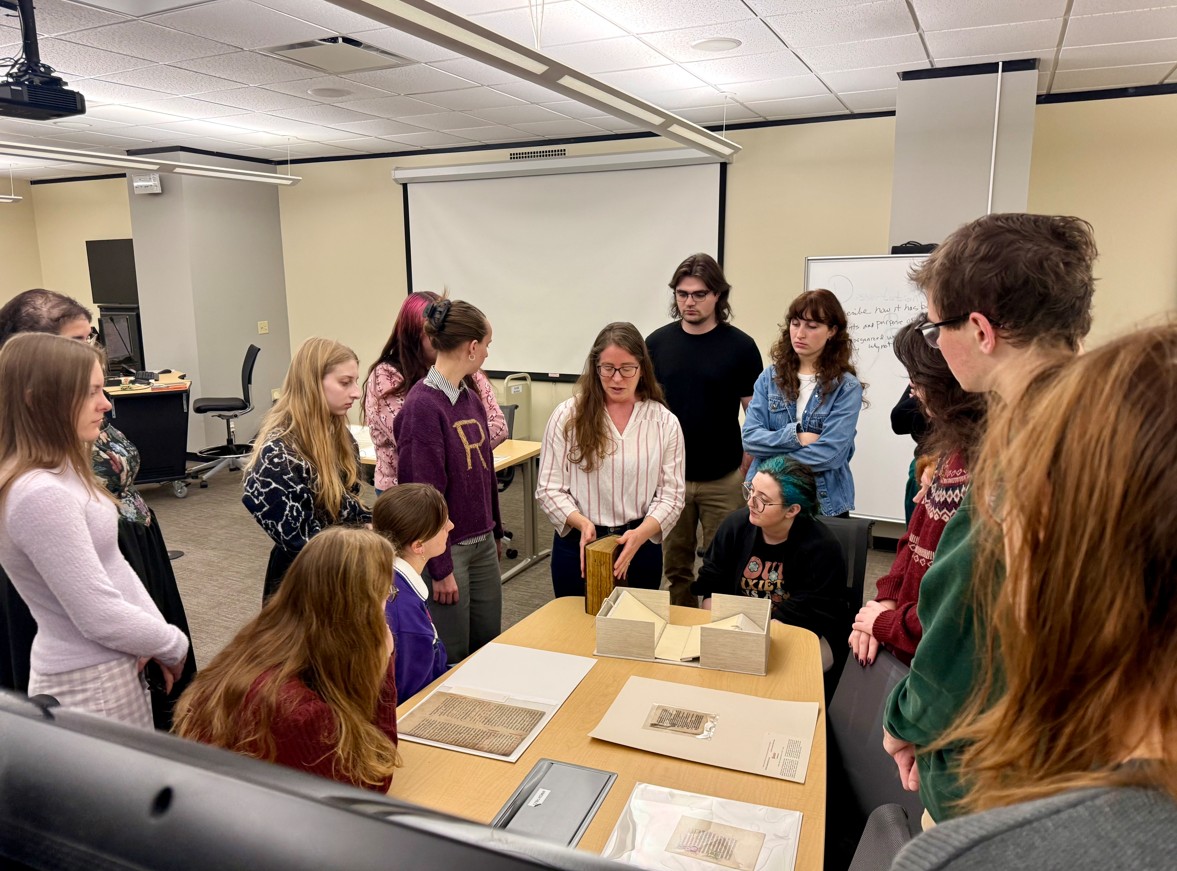
Ohio University students study rare Latin manuscripts up close during a collaborative session in Alden Library.
A firsthand account of history
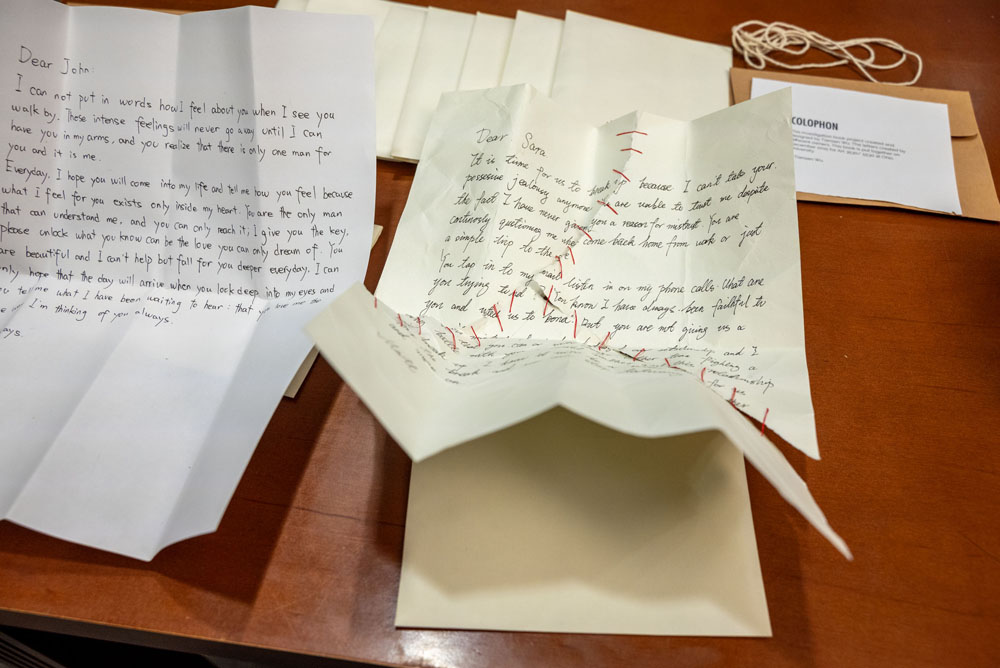
Items like these historical love letters allow students to forge a personal connection with the past.
That sense of discovery is precisely what the archives staff hopes to foster. By presenting students with primary sources, they empower them to draw their own conclusions.
“It’s kind of fun to have it in front of you and figure it out for yourself, rather than having to be told second or third, or fourth hand,” says Kimok. “Critical thinking is probably the most important thing that separates educated college students from others.”
This process forges a tangible connection to the past. Intrator has seen it happen when a student holds a book signed by Virginia Woolf, realizing, “she touched the same book that I'm touching, right? That can be an extremely moving and impactful experience.”
Kimok sees it when he shows students handbooks from the 1960s, revealing how different university life was for men and women.
“It gives them a chance to, at least with the University Archives, to put themselves in the place of people who came before them and establish a connection to the past,” he says. He often works with student journalists from The Post, helping them find unique stories that have never been told, from 1930s love letters to the football team’s 1932 meeting with President Herbert Hoover.
This connection to history is open to all students, for any reason.
“You don't have to be doing ‘serious’ research,” says Intrator. “You can be working on a class paper or a project or thesis, but you can also be pursuing a personal interest.”
The first step, they all agree, is the easiest.
“Reach out and tell us what you’re interested in so that we can offer up an array of what might be useful or interesting,” Intrator encourages. “Anyone can access any of our materials. And we really encourage everyone to not hesitate to do so.”