
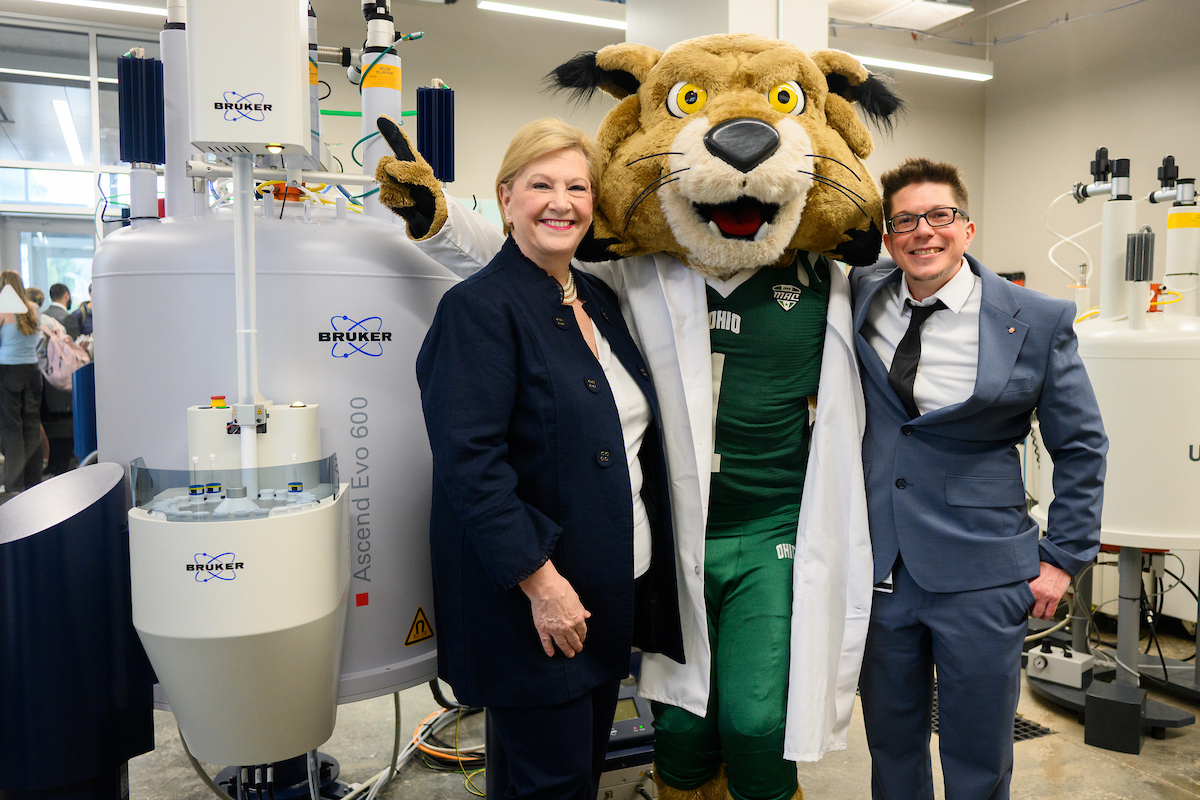
Ohio University unveils powerful new 600 MHz NMR spectrometer, expanding research opportunities for faculty and students
A new high-tech spectrometer is helping Ohio University researchers see the unseen. By revealing molecular structures with extraordinary precision, the instrument is poised to accelerate discoveries in fields ranging from medicine and drug development to advanced materials and chemical research.
Samantha Pelham Kunz | June 24, 2026
Share:
Ohio University has recently acquired a new instrument that will allow scientists to look even more on the microscopic level, getting a better look at detailed structures of molecules that are the foundation for everything from medicines to materials.
On March 20, the Department of Chemistry and Biochemistry in the College of Arts and Sciences officially unveiled its new 600 MHz nuclear magnetic resonance (NMR) spectrometer, a major investment that expands the University’s analytical capabilities and strengthens its position as a competitive R1 research institution.
The celebration brought together members of the OHIO community, including undergraduate and graduate students, faculty, alumni, industry partners and University leadership. President Lori Stewart Gonzalez joined Vice President for Research Eric Muth and other University Leadership for a ribbon-cutting ceremony that marked the instrument’s official debut.
For Felix Roberts, an assistant professor of instruction and the NMR Facility Manager, who works closely with the spectrometers, the moment represented far more than a technical upgrade.
“This isn’t just a new piece of equipment, it’s transformative for what we can do,” Roberts said. “The 600 is so important because you can tackle more complex samples and start looking at peptides and proteins. It really puts us in competition with other research facilities at the R1 level.”
A closer look at molecules
A NMR spectrometer, operating using similar technology as a MRI, uses an extremely powerful superconducting magnet and radio waves to probe how atoms are connected within a molecule. Instead of producing an image, it generates a detailed “fingerprint” that reveals molecular structure - information essential to fields like drug discovery, biochemistry and materials science.
With the addition of the 600 MHz instrument, which joins the University’s existing 300 MHz and 500 MHz spectrometers, OHIO can now analyze more complex compounds with greater precision than ever before.
“If you think of the 300 as looking at a molecule with your own eyes, the 500 is like putting on glasses,” Fumito Saito, an assistant professor of organic chemistry, said. “And the 600 is like using a microscope. The higher the number, the better the resolution.”
That improved resolution allows researchers not only to confirm expected chemical structures but also to detect subtle, unexpected components that might otherwise go unnoticed.
“Something unexpected makes me excited because it can lead to discovery,” Saito said. “With higher sensitivity, you don’t miss that one percent of something unusual. That can lead to new chemistry and new molecules.”
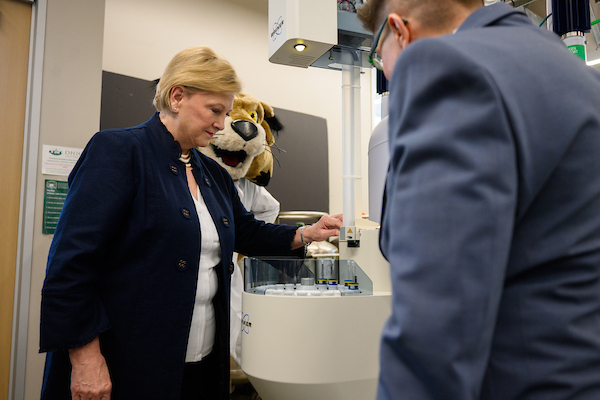
President Gonzalez examines how the new spectrometer works.
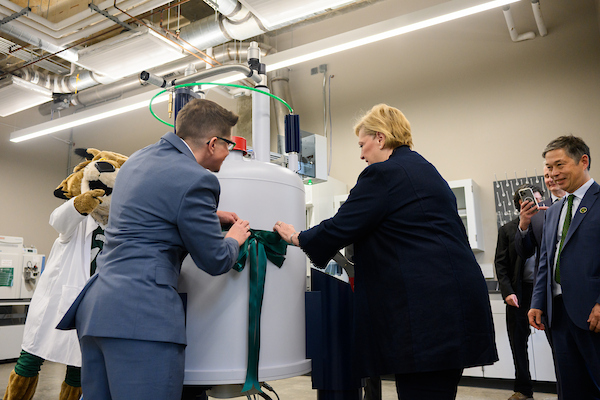
Felix Roberts and President Gonzalez cuts the ribbon during the unveiling.
Expanding research capacity across campus
Although the 300 and 500 MHz spectrometers are necessary for research, the 600 MHz system is particularly valuable for complex biological and chemical samples, including peptides, proteins and other large molecules.
Saito noted that organic chemistry research often depends on determining the precise three-dimensional structure of molecules after synthesis.
“A molecule isn’t just a flat structure, it has a three-dimensional shape,” he said. “With better resolution and sensitivity, we can determine that structure more accurately.”
That capability is especially important in drug discovery, where molecular shape determines how compounds interact with biological targets.
The instrument also improves efficiency. Because of its sensitivity, more advanced analyses, including carbon and hydrogen measurements, can be completed more quickly, opening the door for expanded undergraduate and graduate use.
Testing solutions and solids
For Edward Saliba, assistant professor of chemistry and biochemistry, who specializes in solid-state NMR, the new system also reshapes how the facility operates.
While solution-state NMR, where samples are dissolved in liquid, is the most common approach, solid-state NMR allows scientists to study materials that do not dissolve easily, including complex biological solids and advanced materials.
“With the 600, we can move most solution-state experiments there and free up the 500 for primarily solid-state work,” Saliba, an assistant professor of chemistry and biochemistry, explained. “That expands flexibility for the whole facility.”
He added that the upgrade improves signal clarity and sensitivity significantly.
“At higher field strength, we expect about a 20 percent improvement in resolution compared to the 500, and nearly double compared to the 300,” he said. “That makes it much easier to distinguish overlapping signals.”
Saliba also noted the broader impact on collaboration, including ongoing work with multiple research groups and labs, where the upgraded instrumentation will allow more diverse experiments and faster output.
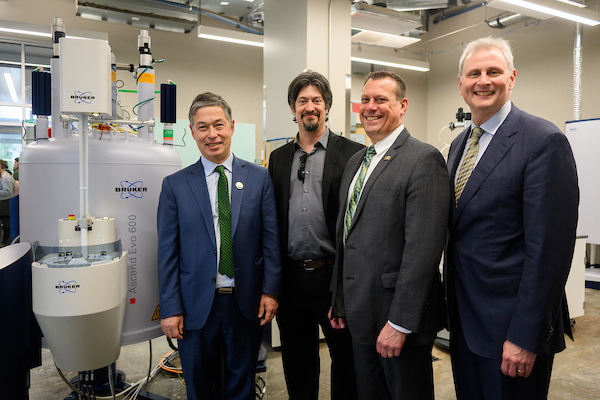
(left to right) College of Arts and Sciences Dean Matt Ando, Professor and Chair of Chemistry Eric Masson, Vice President for Research and Creative Activity and former Executive Vice President and Provost Don Leo share in the excitement around the new state-of-the-art instrument that will be critical to research.
Experiential learning for students
Beyond research, the 600 MHz spectrometer is expected to play a transformative role in education.
“When you’re going into any scientific field, you’re going to use some type of analytical instrumentation,” Roberts said. “Having access to something like this and being trained on it as an undergraduate or graduate student is incredibly important.”
Students will gain hands-on experience with the same type of technology used in pharmaceutical, biotech and materials science industries, to name a few. That includes learning how to prepare samples, typically dissolving compounds in liquid and placing them into thin glass tubes, designing and conducting experiments, and how to interpret the results.
Roberts emphasized that the instrument will also make advanced training more accessible, not just for research students but for classroom learning as well.
“We want to make this kind of instrumentation more approachable,” he said, noting that the facility already provides one-on-one and small-group instruction.
That outreach includes programs like STEM Start, which introduces incoming undergraduate students to research tools before their first semester even begins. In past sessions, more than 60 students have toured the NMR facility and participated in workshops involving NMR and mass spectrometry.

Students, faculty, staff and community members gather to celebrate the unveiling of the new research instrument.

Attendees of the event learn more about the spectrometer.
Research and discovery
The benefits of higher field strength extend beyond clarity, also changing what scientists can discover.
“In research, if everything works exactly as expected, it’s good—but also a little boring,” Saito said. “Something unexpected is what leads to discovery.”
Higher sensitivity ensures that even minor chemical byproducts, sometimes less than one percent of a reaction, can be detected and studied.
“That small amount can be the most interesting part,” he added.
The 600 MHz system also improves three-dimensional structural analysis, allowing scientists to more accurately map how atoms are arranged in space, not just how they connect on paper.
The new spectrometer is expected to serve not only Ohio University but also regional partners, industry collaborators and neighboring institutions. Plans are underway to expand access for external users and to increase sample submission and training opportunities.
“One of the main draws of being at OHIO is the students and the community,” Roberts said. “We work closely with students at all levels, and we want to keep making this technology more accessible.”
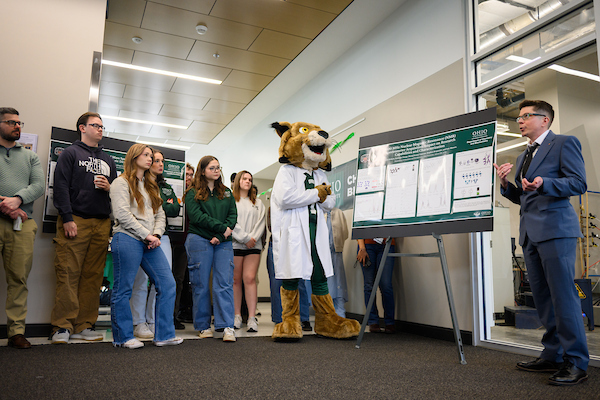
That accessibility extends even to unexpected demonstrations. During the unveiling event to give those attending a better idea of what this type of instrument can do, researchers analyzed Rufus’ favorite treat, catnip, looking at the pureness of the catnip and how many compounds are in the oil. This demonstration offered a fun example of how NMR can identify and quantify the chemical components of everyday materials.

College of Arts and Sciences Dean Matt Ando speaks during the unveiling event.

Professor of Chemistry and Department Chair Eric Masson presents to fellow faculty, staff, alumni, students and community members during the unveiling.
A stronger position in research
With the addition of the 600 MHz NMR spectrometer, Ohio University strengthens its standing among top-tier research institutions while giving students and faculty access to state-of-the-art tools.
It also completes a powerful trio of instruments, the 300, 500, and 600 MHz systems, that together expand the University’s ability to study everything from simple organic compounds to complex biological structures.
As Roberts put it, the impact goes beyond the instrument itself.
“It changes what we can ask,” he said. “And when you can ask more complex questions, you can make more complex discoveries.”