Image
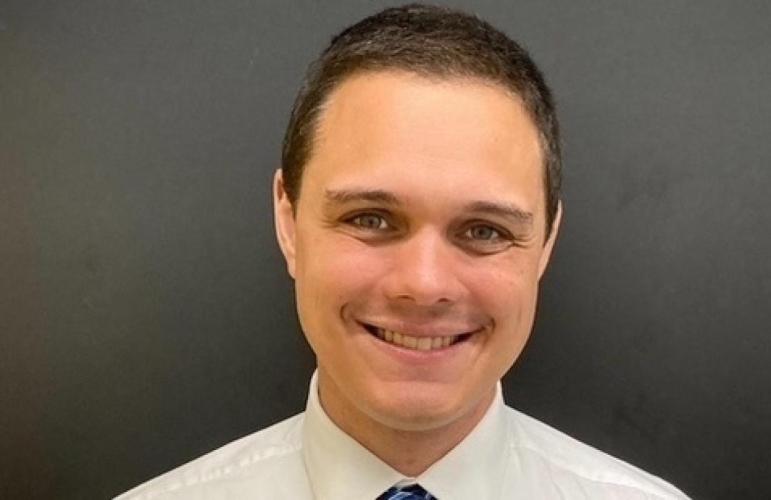
Professor Edward Saliba has officially joined the Nanoscale and Quantum Phenomena Institute (NQPI) at Ohio University, bringing with him expertise in solid-state nuclear magnetic resonance (NMR) spectroscopy and advanced materials characterization. His addition further strengthens NQPI’s growing interdisciplinary research ecosystem spanning chemistry, physics, engineering, materials science, nanotechnology and quantum research.
Saliba joined Ohio University last year as a faculty member in the Department of Chemistry and Biochemistry at College of Arts and Sciences. His research focuses on developing advanced NMR instrumentation and methods to study the atomic-scale structure and behavior of complex materials. According to Saliba, one of the major reasons he chose to join NQPI was the welcoming and collaborative environment fostered by NQPI leadership and faculty members.
“The interdisciplinary nature of the institute was also an attractive attribute that encouraged me to join,” Saliba explained. “I am excited to work not only with my colleagues in Chemistry and Biochemistry, but also with researchers in physics, engineering, and related departments. I think this could foster some really cool collaborations.”
Solid-state NMR is one of the most powerful techniques available for probing the atomic-level structure of materials. Saliba often describes NMR to non-specialists as being conceptually similar to MRI technology used in medicine, except that it studies chemicals and materials rather than human tissues. By detecting tiny differences in magnetic environments surrounding atomic nuclei, NMR can reveal structural and chemical information with remarkable precision.
This capability makes NMR especially valuable for many of the research areas represented within NQPI, including quantum materials, nanomaterials, polymers, biomaterials, and energy-storage systems. Saliba highlighted battery research as one particularly important application, noting that modern solid-state NMR is widely used to study how lithium-ion batteries degrade during repeated charging and discharging cycles. Such studies can provide critical insights for improving future energy-storage technologies.
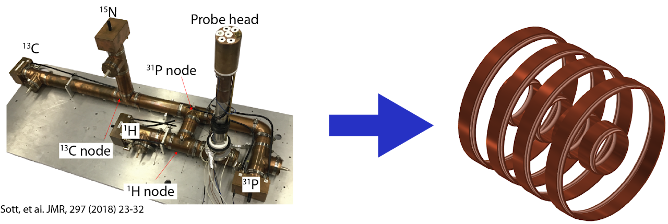
One of the distinctive strengths Saliba brings to NQPI is his laboratory’s emphasis on broadband, highly flexible instrumentation development. His group is currently building segmented transmission-line NMR probes designed to significantly expand experimental capabilities.
During his NQPI seminar last spring, Saliba generated strong interest among faculty and students and quickly established several collaborative projects across the institute. Current collaborations include work with Professor Wenyang Gao on covalent organic frameworks, discussions with Professor Katherine Cimatu on nitrogen-doped graphene quantum dots, computational modeling collaborations with Professor Nancy Sandler, and materials characterization studies with Professor Gang Chen. He also credited Professor Martin Kordesch for valuable guidance on instrumentation development.
Saliba expressed strong enthusiasm for mentoring students and supporting the broader scientific community at Ohio University.
“I love teaching and interacting with students and other scientists,” he said. “If anyone has questions on NMR instrumentation, methods, or theory, I would gladly sit down and discuss it with them.”
With expertise spanning instrumentation, spectroscopy, computational integration, and advanced materials characterization, Saliba’s arrival represents another important step in expanding NQPI’s shared research infrastructure and interdisciplinary collaborations in quantum science and nanotechnology.