Image
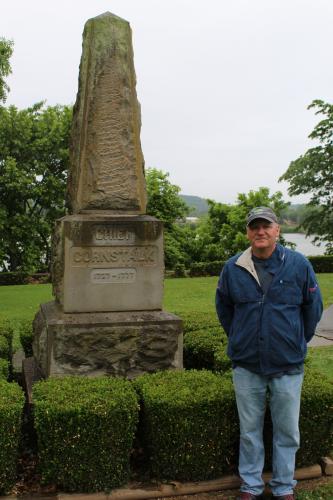
Jim Lee standing next to the grave of his 4th great uncle, Shawnee Chief Cornstalk, at Tu-Endie-Wei State Park in Point Pleasant, West Virginia.
Jim Lee’s family tree grows from both sides of the Ohio Valley frontier.
His fourth great-grandfather, Silver Heels, was the brother of Shawnee chiefs Cornstalk and Nonhelema, who led their people through the wars of the 1700s. Other branches of his family were European settlers pushing onto Shawnee land, and more than once, the two sides of his family met in battle.
Lee, a member of the Shawnee Tribe and the Cherokee Nation, will share that story at Ohio University Southern on Friday, Nov. 13, during “Native Leaders of the Ohio Valley,” part of campus Native American Heritage Month programming. His talk runs from 9:30 to about 10:30 a.m. in Bowman Auditorium and is free and open to the public.
“I talk about the history of the Shawnee from the 1600s through the time they left Ohio,” Lee said. “But I include my American European family, the interaction between the two, which is considerable.”
Much of that history unfolded close to campus.
The state’s name comes from ohi-yo, an Iroquoian word meaning “the great river,” and the Shawnee built towns along that river and its tributaries. In the 1750s, Silver Heels traded with the English at Lower Shawnee Town, at the mouth of the Scioto River where Portsmouth stands today.
In 1774, Cornstalk led about 1,200 Shawnee, Mingo and Delaware warriors against the Virginia militia at the Battle of Point Pleasant, just upriver from Ironton. Three years later, he was killed at Point Pleasant while on a peace visit to an American fort.
Cornstalk is buried there today, and his grave is part of the National Park Service’s Underground Railroad Network to Freedom. The recognition honors his refusal to return two children of a freedom seeker to their enslavers, a story the park service asked Lee and his cousin, Dorene Soiret, to help tell.
The conflict reached into Lee’s own family tree. His fifth great-grandfather, John Hutcheson, a Scottish immigrant, was killed in 1758 when French, Shawnee and Delaware forces burned Fort Upper Tract in what is now West Virginia. Lee believes his Shawnee ancestors were very likely part of that attack. Hutcheson’s daughter, Lee’s fourth great-grandmother, wasn’t at the fort.
“If they’d killed her too, I wouldn’t be here,” he said.
Lee and his wife, Jeri, began researching their families in 1979 at the public library in Ponca City, Oklahoma, and added DNA studies in 2008. He served as vice chair of the Shawnee Tribe’s inaugural Historical and Cultural Preservation Committee and is a board member of the Shawnee Indian Mission Foundation in Fairway, Kansas. A chemist by training, Lee spent 40 years in the oil and gas industry.
His talk follows the Shawnee out of the Ohio Valley after the Indian Removal Act of 1830, first to what is now Kansas and then, in 1867, to Indian Territory in present-day Oklahoma. The Shawnee Tribe regained its sovereignty in 2001. Today, all three federally recognized Shawnee tribes are based in Oklahoma.
“They always say, tell them we’re still here,” Lee said.
“As our nation marks its 250th anniversary, it’s worth remembering that the Ohio Valley’s story began long before 1776,” said Robert Pleasant, director of student services at OHIO Southern. “We’re proud to welcome Jim Lee and give our students and community the chance to learn the Shawnee people’s history from someone whose family helped shape it.”
For visiting students, the day continues after the talk with an art activity led by Third & Center, followed by lunch. The student program is also free, and teachers are invited to register their classes.
Native American Heritage Month has been observed nationally each November since 1990, when President George H.W. Bush approved a resolution designating November as National American Indian Heritage Month.