Image
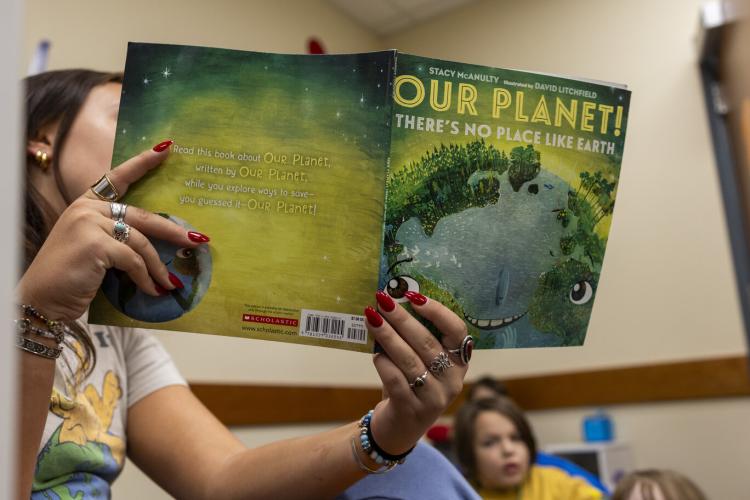
The Center's Green STEM afterschool club.
The Patton College of Education’s Stevens Literacy Center has a long history of supporting literacy development across ages, settings and communities. Building on that foundation, the center has been reenvisioned and renamed the Stevens Center for Literacy and STEM Education, a change approved at the October Board of Trustees meeting. The new name reflects the strong literacy and STEM education efforts already underway and signals a renewed commitment to research, collaboration and community partnerships.
Co-directors Julie Barnhart Francis and Courtney Koestler describe the shift as an intentional amplification of strengths rather than a departure from the center’s roots.
“We’re bringing together the rich and wonderful work Julie has done in literacy with the STEM education work I’ve been doing,” Koestler said. “The center is envisioned as a hub that supports faculty across the Patton College and the University, as well as partners in the community. We’re using a broad, creative definition of literacy which includes STEM-related literacies too.”
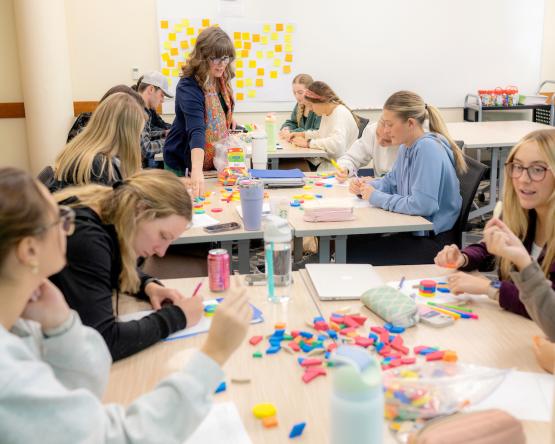
“We’ve had a lot of synergy in the past,” Barnhart Francis added. “This change allows us to be more intentional. We’re not starting over, we’re building on strong foundations and broadening what’s possible. It’s a way to support colleagues across the University and our partners.”
Associate Dean for Research and Graduate Studies Danielle Dani, who oversees the college’s centers, explained that the shift stems from both the strengths already present within the college and the need for a structure that better supports interdisciplinary and sponsored research.
“The Stevens Center was already engaging in literacy education and STEM education teaching and outreach,” Dani said. “Changing the name and structure acknowledges the significant STEM Education focus of the center, pools resources to support both areas individually and collectively, and amplifies the center’s focus on education research.”
In reviewing the college’s centers, Dani and her team saw opportunities for greater impact.
“It made sense to reexamine our roles, operations and how we could catalyze teaching, research and outreach across colleges, departments and communities,” she explained. “Merging literacy and STEM education work was a natural step because literacy, in its broadest sense, extends far beyond reading and writing. It includes disciplinary literacies, such as scientific and quantitative literacy, that are essential for engaged citizenship and public life.”
Dani noted that faculty across the college were already working in “niches of excellence,” such as health and wellness, STEM education, rural education and more. She shared that this research often involved collaborations with researchers from different fields of expertise, both from within and outside OHIO.
“We want to leverage and replicate these types of intentional and interdisciplinary collaborations to increase our capacity to tackle complex societal challenges,” she said. “We are creating an affiliated faculty community model to expand the intellectual and disciplinary footprint of the center, cultivate new collaborations, pursue new funding opportunities and spark interdisciplinary research that has broader impact.”
With the new structure, Koestler said the center aims to become an academic home where researchers, educators and community partners can come together to strengthen existing projects and imagine new ones.
“The center will support collaborative projects connected to literacy and STEM education and will emphasize creative, innovative partnerships.”
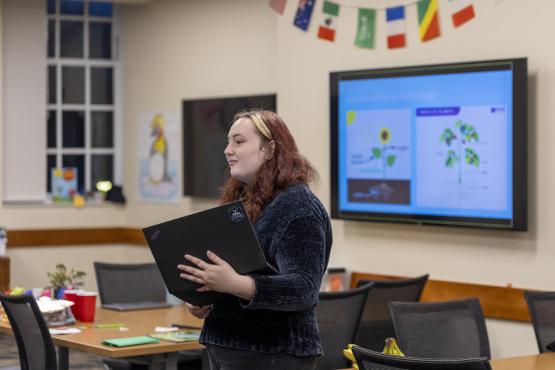
Barnhart Francis described the center as a place where ideas can take root and bring together people who may not normally work together but have similar goals.
“The center is a space where everyone has the capacity to work with or through it. We can bring in new ideas and highlight the work already happening,” she said. “This new structure will be an opportunity to support colleagues, local schools, adult education and more happening within our community.”
According to Koestler, the expanded model supports work across a broad definition of literacy encompassing reading, writing, quantitative literacy, cultural literacy, health literacy and STEM-related literacies. Much of the center’s work emphasizes critical literacy, helping students analyze and question information in empowering ways.
One example of this is in critical mathematical literacy, where Koestler leads the NSF-funded Connecting Math project,, which supports teachers in linking mathematics instruction to real-life topics meaningful to students.
“Many STEM projects in and around the University need educational expertise, and the center offers a place where those partners can find skilled collaborators who understand education research and outreach,” Koestler said.
Barnhart Francis also highlights the center’s continued work in adult literacy and workforce readiness education, supported by a major state grant since 2018, as well as her ongoing efforts in rural education.
“The center is grounded in rural education and the experiences they provide to teacher candidates. These experiences, such as participating in STEM and literacy nights in local schools, are essential for students and help spark important conversations,” Barnhart Francis added.
The center’s long-standing summer programming is another example of how literacy and STEM continue to merge in innovative ways. Barnhart Francis highlighted the work they are doing with their out-of-school summer camp, a month-long program serving elementary-age students and youth.
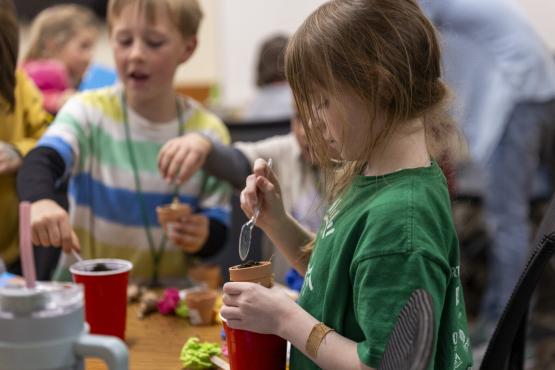
“We are developing more interdisciplinary approaches that integrate literacy with math, environmental learning and social studies,” she said. “We can bring in experts in science and civics to expand summer programming in joyful, hands-on ways that address summer learning loss. The program already partners with the Office of Sustainability and the Institute for Sustainable Energy and Environment but we are working to do even more.”
Dani emphasized the center’s longstanding commitment to reciprocal community partnerships, highlighting how these relationships not only support local organizations in achieving their goals but also provide students with meaningful, hands-on learning experiences that connect classroom knowledge to the real-world.
“The center helps support community organizations in achieving their goals while giving our students meaningful experiential learning opportunities,” Dani said. “In one example, graduate students from three courses worked with the Stevens Center, two partnering schools and two regional community centers to develop informal learning objects that were used to foster youths’ mathematics and literacy skills, create interactive museum exhibits, and combat summer reading loss.”
Dani also highlighted the untapped potential of investigating the mechanisms and outcomes by which partnerships such as these translate research to practice. Dani said, “From a research perspective, we want to actively integrate community voices, including those historically underrepresented, to ensure our findings accurately reflect their experiences and effectively inform policy and practice.”
Koestler added that the center’s broadened scope supports a more critically literate society.
“Whether we’re talking about reading, math or science, literacy is about helping people ask questions, analyze information and use tools to understand their world,” Koestler said. “The work we’re doing in teaching, outreach and research contributes to that every day.”
The Stevens Literacy and STEM Center remains located on the second floor of the Patton College (Suite 218), with an annex meeting space in Suite 321. An open house will be held Dec. 4 at 4 p.m., welcoming faculty, staff, and community partners to engage with the center’s work and goals.