Image
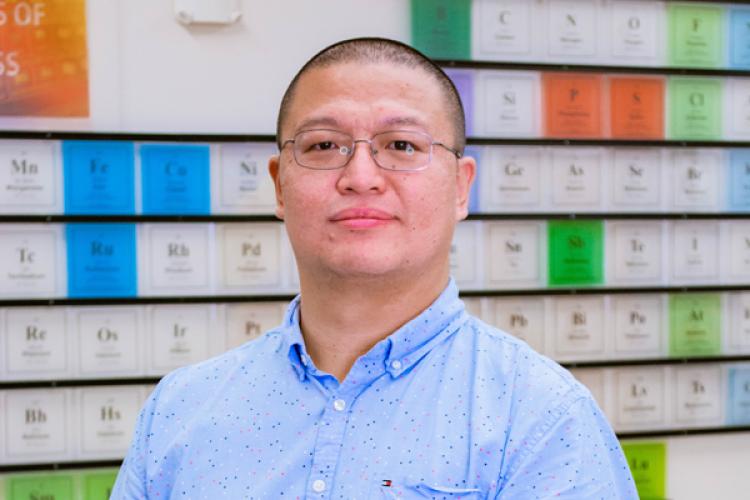
Dr. Wenyang Gao
What if making advanced materials didn’t require harsh chemicals, high heat, or large amounts of solvent?
Dr. Wenyang Gao, assistant professor of chemistry and biochemistry at Ohio University, is turning that idea into reality. Gao has received a prestigious CAREER Award from the U.S. National Science Foundation Division of Materials Research (DMR)—one of the agency’s highest honors for early-career faculty.
The five-year award (totaling $875,763) supports Gao’s effort to rethink how materials are made at the most fundamental level. Instead of relying on traditional liquid-based chemistry, his team uses mechanical force—grinding or milling solids—to drive reactions, enabling faster, cleaner and more energy-efficient synthesis.
Gao’s research centers on mechanochemistry, an emerging approach that replaces conventional solution-based reactions with solid-state processes. By doing so, the work opens access to materials and structures that are often difficult—or impossible—to obtain under traditional conditions.
The goal is not just to make materials differently, but to understand why these solid-state reactions lead to new outcomes, providing fundamental insights that could impact energy technologies such as batteries, catalysis and environmental remediation.
In Gao’s lab, students are not just learning chemistry—they are doing it.
Undergraduate and graduate researchers will design experiments, synthesize new materials and analyze their properties using advanced techniques. The CAREER project also expands outreach across Appalachian Ohio through hands-on workshops that bring "chemistry without liquids" to K–12 classrooms.
"We’re changing the rules of synthesis," Gao said.
"We’re challenging the assumption that materials must be made under harsh, solution-based conditions," Gao said. "By working in the solid state, we can access structures and reactivity that were previously out of reach—while making chemistry more sustainable and accessible."
The project integrates synthesis with advanced characterization techniques, including powder X-ray diffraction, spectroscopy and gas adsorption measurements, to uncover how structure forms and evolves during solid-state reactions.
By establishing mechanochemistry as a predictive and controllable synthetic platform, Gao’s team aims to lay the groundwork for next-generation materials design.
The CAREER Award recognizes both research innovation and commitment to education. The project will train students in cutting-edge chemistry while expanding access to hands-on STEM learning in the region.
Gao has previously received NSF support for related research, and this new award builds on that momentum—further strengthening Ohio University’s role in advancing sustainable materials chemistry.