Image
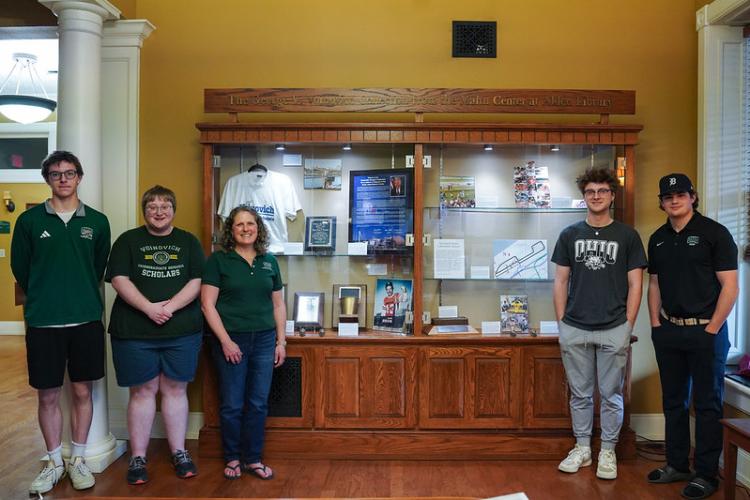
An archival research project conceived with the help of Voinovich Undergraduate Research Scholars has produced an informative exhibit to celebrate the legacy of Ohio University alumnus George V. Voinovich.
Voinovich was well known as a consummate public servant, having worked up the ranks from Cleveland mayor to state lawmaker to governor and finally U.S. Senator. The four OHIO students involved in the project were most interested in showcasing details of some of the late official’s policy aims and accomplishments.
The result of the work by current and former students Laker Aldridge, Talyn Doss, Cody Englander and Madison Wells is a display in Building 21 on the OHIO campus that highlights some of the history behind the man who lent his name to the George V. Voinovich School of Leadership and Public Service.
Their work, organized by the Voinovich School’s Dr. Holly Raffle, was not easy given the vast volume of the Voinovich collection in the OHIO archives, according to Greta Suiter, the manuscripts archivist at the Mahn Center for Archives and Special Collections, Preservation and Digital Initiatives.
The George Voinovich collections are by far the largest under her purview, she said.
“Combined, they are almost 2000 cubic feet - or 2000 record cartons. There is so much material that it is easy to feel overwhelmed as a researcher or an archivist. Luckily when working with the students on this exhibit, they already had rough ideas of what they wanted to highlight about Voinovich and we just needed to find the right items to bring those ideas to life,” Suiter said.
“The students did an amazing job of physically looking through the objects and finding ones to include in their exhibits," Suiter said. "I love being able to work with students in this way and the final exhibit is wonderful.”
Raffle said the students worked diligently to create an outstanding display.
“Meeting every week surrounded by items from the George V. Voinovich Collection, the scholars became deeply curious about the Senator’s impact on Ohio and Ohio University,” Raffle said. “After reading his biography, their curiosity turned into a clear mission. By transforming the display cases into a student-curated exhibit, they are bringing Senator Voinovich’s legacy to life in a way that is engaging, accessible and meaningful for the entire community.”
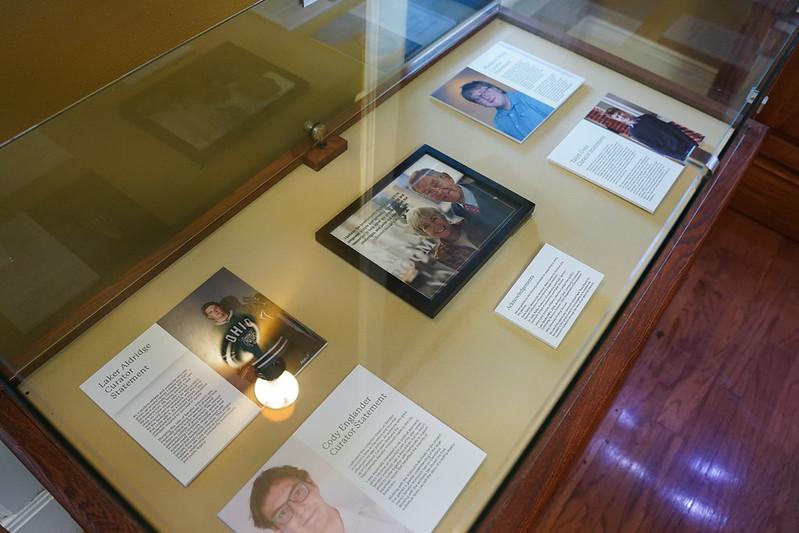
The students detailed their individual interests in Voinovich’s history through “Curator's statements.”
For example, Wells, a senior social work student and preventionist, expressed interest in learning about and showcasing Voinovich's work with children and families of Ohio. Those activities included his initiatives involving: Ohio's Children and Family First Council; early childhood intervention and school-based programs such as Head Start, child healthcare coverage and welfare reform.
“Studying the career of George Voinovich has helped me better understand how state leadership can expand access to education and early intervention services,” Wells wrote. “This project has reinforced the importance of prevention work and the long-term impact it can have on communities. My experience in the archives has shown me that items like awards and children’s artwork reflect the personal and lasting effects of public service.”
Aldridge noted that during his governorship, Voinovich focused in part on community recreation initiatives and school funding, which benefited athletic programs across Ohio’s school districts.
“As mayor and governor, he supported efforts to keep the Browns, Indians and Cavaliers rooted in Ohio rather than relocating,” Aldridge added. “He worked to revitalize downtown Cleveland, paving the way for sports facilities like the Gateway Sports and Entertainment Complex, which later became home to the Cleveland Indians (now Guardians) and Cleveland Cavaliers.”
Aldridge said one of the biggest things he took away from the project was “learning how involved Senator Voinovich was in sports, especially motorsports and IndyCar.”
“Before doing the project, I really didn’t realize how much sports could tie into things like bringing people to Ohio, helping local businesses and giving the state more national attention. I thought it was really interesting seeing how Voinovich understood that and used his position to support things that were important to Ohio outside of just politics,” he said.
“I also liked being able to look at a different side of Voinovich that you probably wouldn’t learn about just by reading about his political career,” Aldridge said. “His involvement in motorsports showed more of who he was as a person and what he cared about. Overall, the project gave me a much better understanding of the impact he had on Ohio and how sports can actually play a pretty big role in bringing people together and helping a community.”
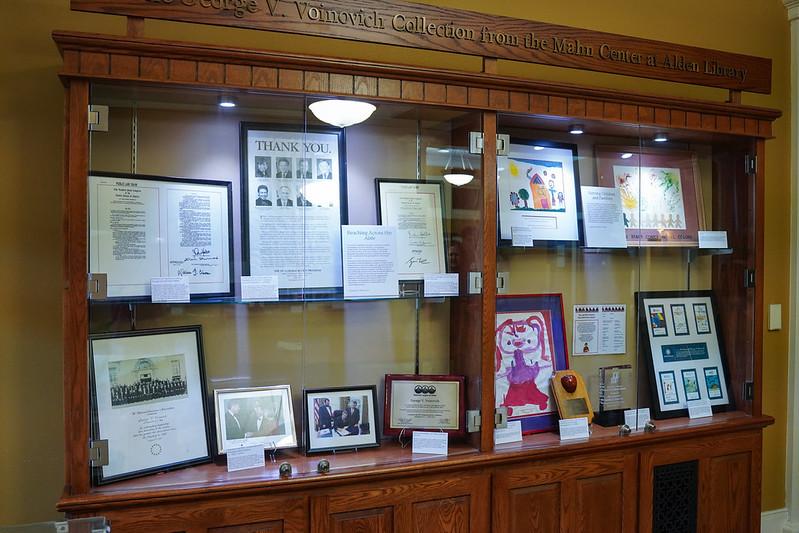
Doss wanted to explore Voinovich’s legacy of bipartisanship throughout his career, which included his membership in the U.S. Senate’s “centrist bloc.” He was also interested in finding out more about the public servant’s penchant for “fiscal responsibility” and “social liberalism” as well as involvements in environmental protection efforts such as Great Lakes restoration, the Diesel Emissions Reduction Act and the Environmental Defense Fund.
“What stood out to me most in the research stage was his ability to build relationships across party lines and find common ground, even when there were significant differences in political views,” Doss said. “Senator Voinovich was known for his ability to see through the difficult process of policy and maintain his focus on delivering results for the issues he, and many Americans alike, believed in. I was drawn to his ability to do so as it becomes an increasingly uncommon ability amongst all politicians.”
“Not only did I learn new things about Senator Voinovich, but also about myself,” Doss added. “The process reinforced for me that effective policymaking often comes from collaboration, compromise, and a willingness to work with people who may not always agree with you.”
Doss said the project also was an eye-opener regarding archival work, calling the opportunity to sift through someone’s personal items and papers “an experience in itself” that “allowed me to see notes, comments, and papers that showed his process in policymaking and his life behind what you would commonly see through the media.”
Englander wrote, “I was interested in seeing what George Voinovich has done in relation to the city of Cleveland. His role reaching across the aisle as the last Republican mayor for Cleveland has been important in shaping the city into what it is today, starting with his ‘Take Another Look. It's Cleveland!’ campaign. He helped to develop downtown Cleveland and really getting into what that looked like and the legislation that led to this is of interest to me as a native of the Cleveland suburbs.”
Englander, a Shaker Heights native who graduated earlier this year, said after the project was finished that helping to review Voinovich’s archives was informative.
“I was able to really investigate how he improved the city,” he said.
Englander cited Voinovich’s efforts to improve housing in the Cleveland area while reaching out with inclusivity initiatives to minority communities.
“He was a big proponent of that, which I think is very crucial,” Englander said.
That work is evidenced by the archive’s inclusion of the Minority Construction Coalition Service Award and Dr. Martin Luther King Jr. Community Leaders Award presented to Voinovich.
The OHIO graduate also underscored how Voinovich was a strong proponent of retaining the Browns in Cleveland, along with his support for developing and locating the Rock and Roll Hall of Fame in the city through public-private partnerships.
“He was really instrumental in that, and it’s really become this sensation of Cleveland,” Englander said.
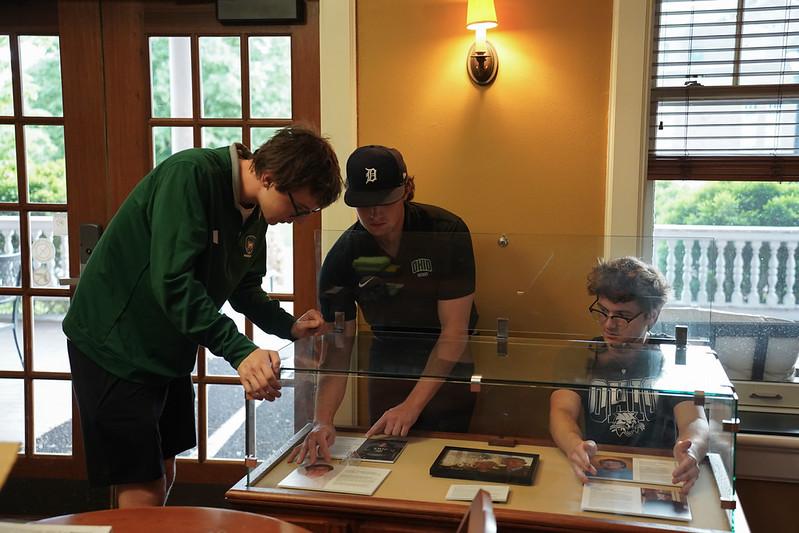
Englander said of the archives project in general, “It was an absolute treat to be able to work with everyone on this,” Englander said. “Being able to work with all my colleagues on this project specifically has made me appreciate group work in a different way. We sifted through a lot of items. We had to do a lot of research.”
Echoing Doss and the other students involved in the project, Englander added, “I’m just really thankful for everyone who contributed to this project from fellow Research Scholars to Dr. Raffle.”
Raffle said the project “became much bigger and more rewarding than any of us originally imagined.”
“Starting with a basic question of how to highlight Senator Voinovich’s service, the scholars immersed themselves in archival research, visited local historical exhibits like the Athens Armory for inspiration, and worked hand-in-hand with University Printing Services to get every artifact, layout and description just right,” she said. “While the students did the core work, it truly took a village to realize this exhibit.”