Image

A generous gift by Ohio University alumnus Ken Reed (’68) made cash awards possible for outstanding student research on musculoskeletal and neurological disorders like osteoarthritis and cognitive decline – research conducted via labs within the Ohio Musculoskeletal and Neurological Institute (OMNI).
“Our scientists are aggressively tackling some of the most fundamental health and medical crises facing our nation,” said Brian Clark, Ph.D., OMNI executive director, introducing the Dr. Ken Reed Distinguished Seminar and Awards Reception Sept. 22. “We strive not only to generate discoveries and new knowledge, but we are deeply committed to translating those findings to directly impact patient health and human lives.”
Clark welcomed Reed, who attended the symposium. After graduating from Ohio University, Reed went on to an advanced degree and a career in dental surgery.
“In addition to OMNI, (Reed and his wife, Gayle) have selflessly funded many other critical initiatives across Ohio University,” Clark noted.
This includes gifts to the Rush Elliott Chair in Biological Sciences, the Ohio Center for Ecological and Evolutionary Studies, the Institute of Sustainable Energy and the Environment, WOUB and Cats’ Cupboard campus food pantry.
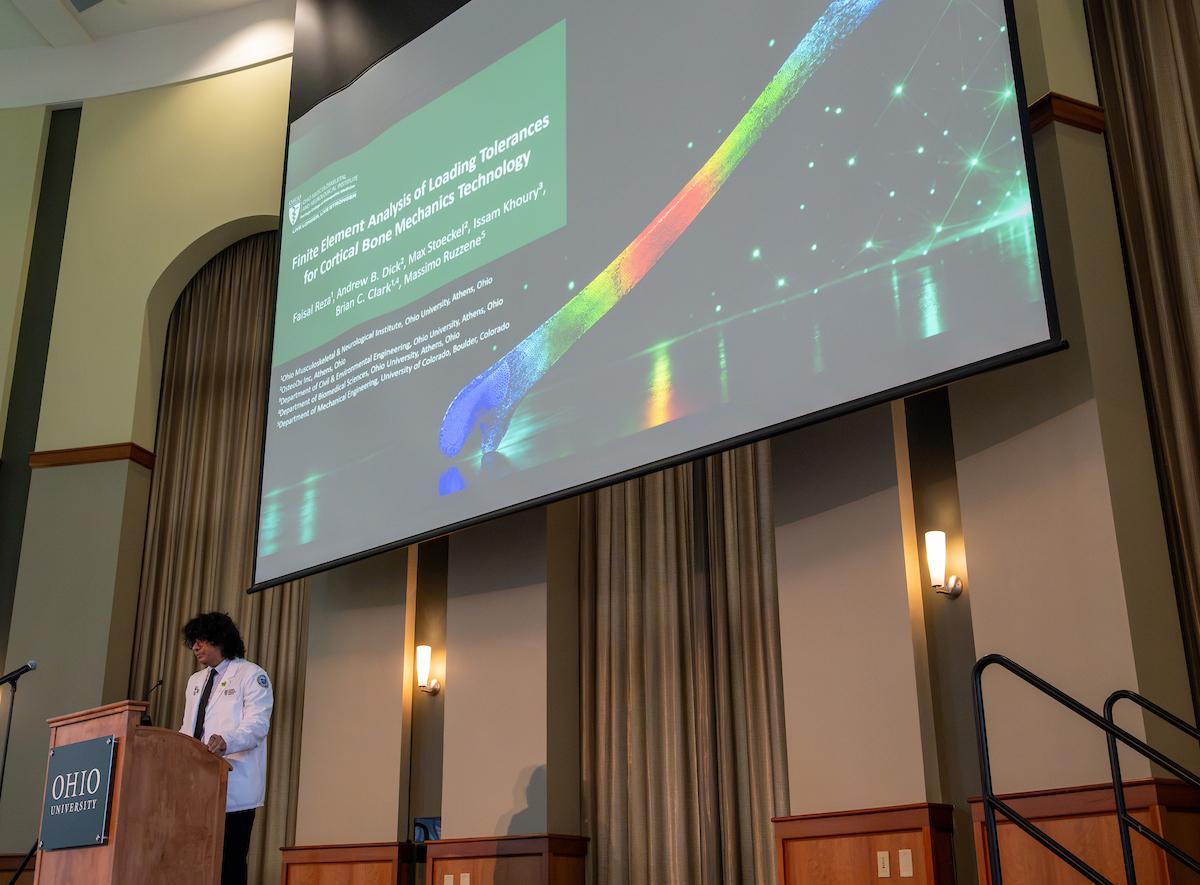
The seminar’s featured student address was by Faisal Reza, a dual-degree D.O./Ph.D. student. Reza’s address, titled “Finite Element Analysis of Loading Tolerances for Cortical Bone Mechanics Technology” discussed research in conjunction with OsteoDX, a private medical technology start-up company that spun out of OMNI research and is creating a pioneering device designed to assess whole bone strength, not just bone density like in widely used DXA scans.
DXA scans “tell us is how much mineral is contained inside of the bone, but not necessarily the mechanical strength of bone,” Reza said. He later added, “We’re doing a lot of cool things at OsteoDX, and I think this machine can get very revolutionary.”
Shouan Zhu, Ph.D., an OMNI principal investigator and Ralph S. Licklider, D.O. Endowed Professor in the Department of Biomedical Sciences, delivered the keynote lecture at the seminar. Zhu and his team are uncovering how aging and obesity disrupt the metabolism of cartilage cells and contribute to joint degeneration. His lecture discussed how they have identified a protective role for the protein SIRT5, showing that its loss worsens joint damage in mice with obesity. These findings point to potential targets for treatments that could slow the disease. Since joining OHIO in 2020, Zhu has built a research program that has attracted around $10 million in competitive grants.
At the end of the symposium, five trainees learned that they earned Dr. Ken Reed Trainee Awards:
Dylan Gibson, D.P.T., and Brett Kowalczyk, D.P.T., both doctoral students in the Translational Biomedical Sciences program, were recognized for research they will present at the American Physical Therapy Association’s Combined Sections Meeting in Philadelphia. Gibson’s research examines how communication between brain regions at rest relates to how people move during a jumping and landing task in virtual reality. Kowalczyk’s research explores how the relationship between brain connectivity and fear of movement changes throughout rehabilitation after anterior cruciate ligament (ACL) reconstruction.
Reed expressed satisfaction in funding leading-edge research, noting that much of the information presented during the symposium was above his head. “That’s the point,” he said.