
Fall 2026 Edition
Alumni & Friends Magazine
Reality, augmented
From immersive virtual reality training to Hollywood-style filmmaking, students and faculty are using cutting-edge technology to transform how we learn, train and create while preparing for today's careers.
Mary Reed, BSJ ’90, MA ’93 | November 24, 2026
Share:
Corey Rogier sits in a small consultation room in a health care setting, absorbing life-changing news: He has Huntington’s disease. To his right, a registered nurse explains treatment options. To his left, a nurse practitioner tries to answer questions about his future and the future of his young child. Rogier feels a hand on his right shoulder. Another hand squeezes his left hand.
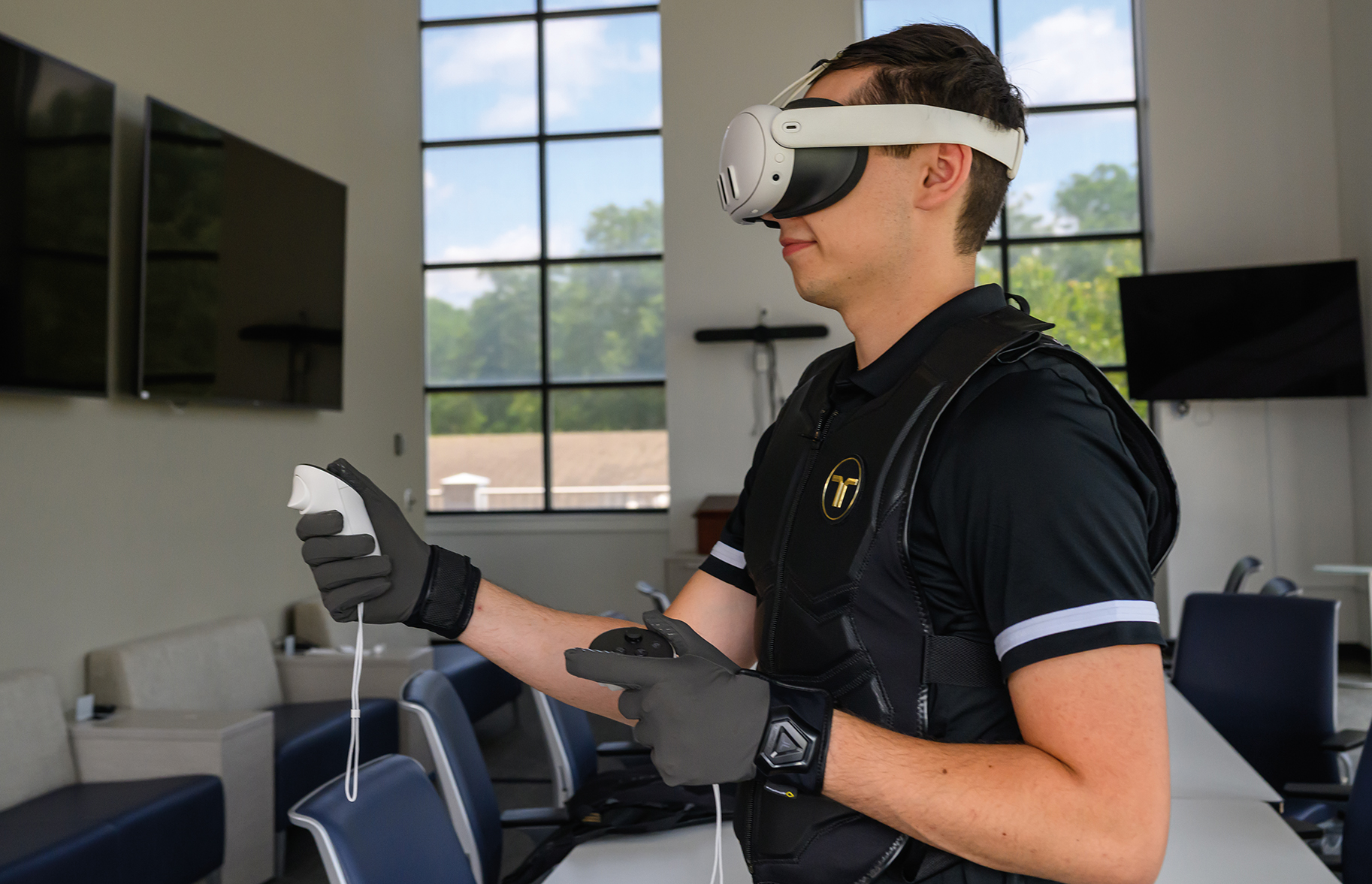
Then he slips off a virtual reality headset and he’s back to being Corey Rogier, master’s student in public health at Ohio University. “I felt sad, even though it was just a scenario,” Rogier says, still wearing the haptic vest and glove that allowed him to feel the comforting hands on him. “Bedside manner is important, and it is integrated in courses, but seeing it through the goggles was a unique situation. Honestly, it didn’t feel like it was scripted.”
Rogier, BS ’24, MPH ’27, has just participated in a cinematic virtual reality experience created by OHIO360, a collaboration between the Scripps College of Communication and the Voinovich School of Leadership and Public Service. This scenario is one of some 35 cine-VR experiences and counting that help teach service-oriented skills like empathy to public employees in the fields of healthcare, law enforcement and more.
Cine-VR takes the components of cinematic movie-making — scripts, sets, actors, lighting, blocking — and records it with a 360-degree camera, embedding the viewer in the scene itself.
“It’s always like, ‘Wow, I will remember this. I think if this happens in real life, I’ll know how to react,’” says Sherleena Buchman, PHD ’16, associate dean of curriculum and academic affairs in the School of Nursing. She has seen cine-VR work as a great learning tool and has helped inform the scripts for the experiences currently used in nursing courses.
“To my knowledge, nobody else has done anything like this,” Buchman adds, pointing to OHIO’s leadership in haptic cine-VR. OHIO has plans to introduce the cine-VR nursing experiences to the online graduate nursing and public health programs, and in 2027 a new academic certificate will be offered, titled Extended Realities in Healthcare.
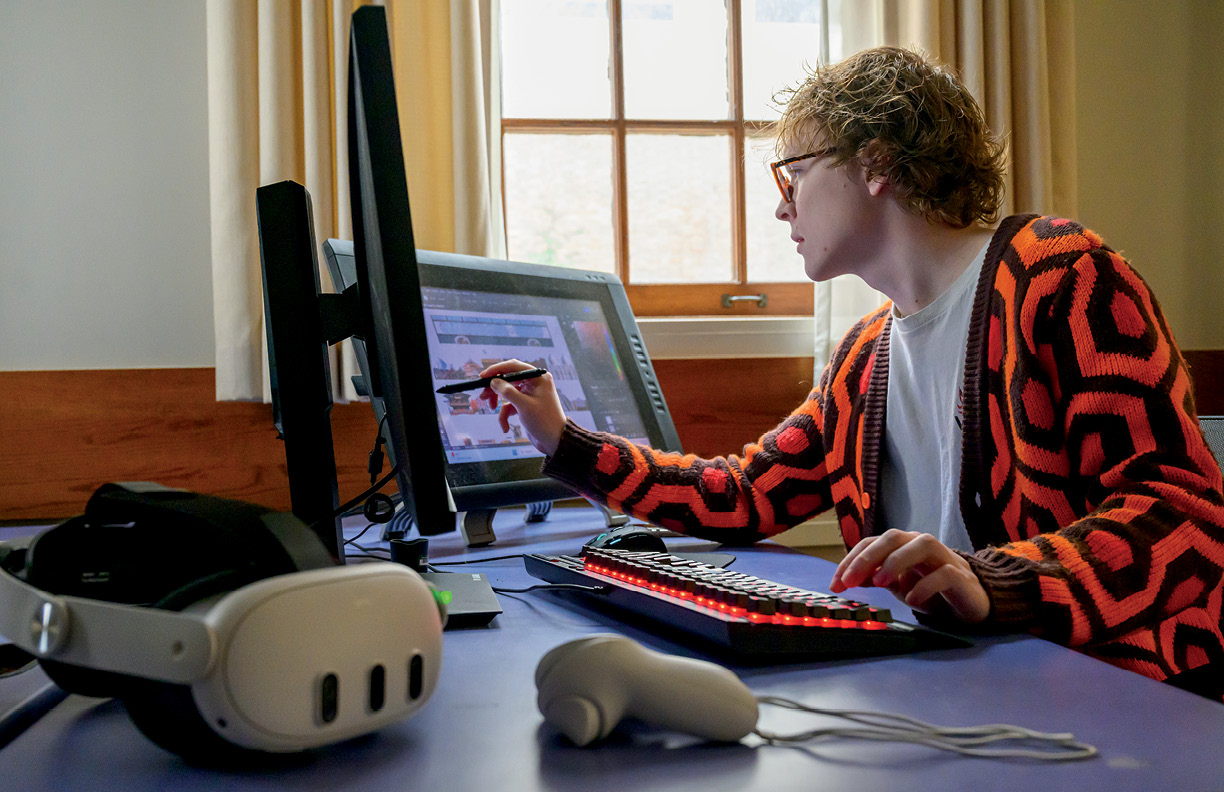
The skills he gained as a lead developer on the OHIO360 cine-VR project helped William Hamilton, BS ’26, land an internship with NASA’s Artemis Project. “Same tools, same workflows,” Hamilton says about the two experiences. Photo by Ben Wirtz Siegel, BSVC '02
VR Training Simulation Supplements Cine-VR Experiences
The GRID Lab has recently released a VR experience app that is a callback to OHIO360 cine-VR script featuring the teenage girl on the bridge. She is a human trafficking victim. Instead of cinematic VR, however, it is an interactive digital crime scene viewed with a VR headset and guided with hand-held controllers. The first person-based 360 experience trains law enforcement to go through the crime scene where the trafficking occurred. The assignment is to identify and select evidence. Scores are assigned to the quality of evidence selected, from an appointment calendar to a cell phone to DNA samples.
Athens and Ohio University police continually tested the project, helping to refine the experience. It is serious, but gamified. “We wanted to gamify it in a way in which you can win and lose” to bring a pass/fail aspect to the training, says William Hamilton, BS ’26, a lead developer on the project.
“It’s the best of what the GRID Lab does, which is make something interactive, immersive and doing it with students,” Hamilton adds. He turned his experience at the GRID Lab into an internship with NASA to create a digital approximation of the moon for the Artemis Project. “I can say 100% that I only got that NASA position because of the work that I’d done at the GRID Lab … Same tools, same workflows.”
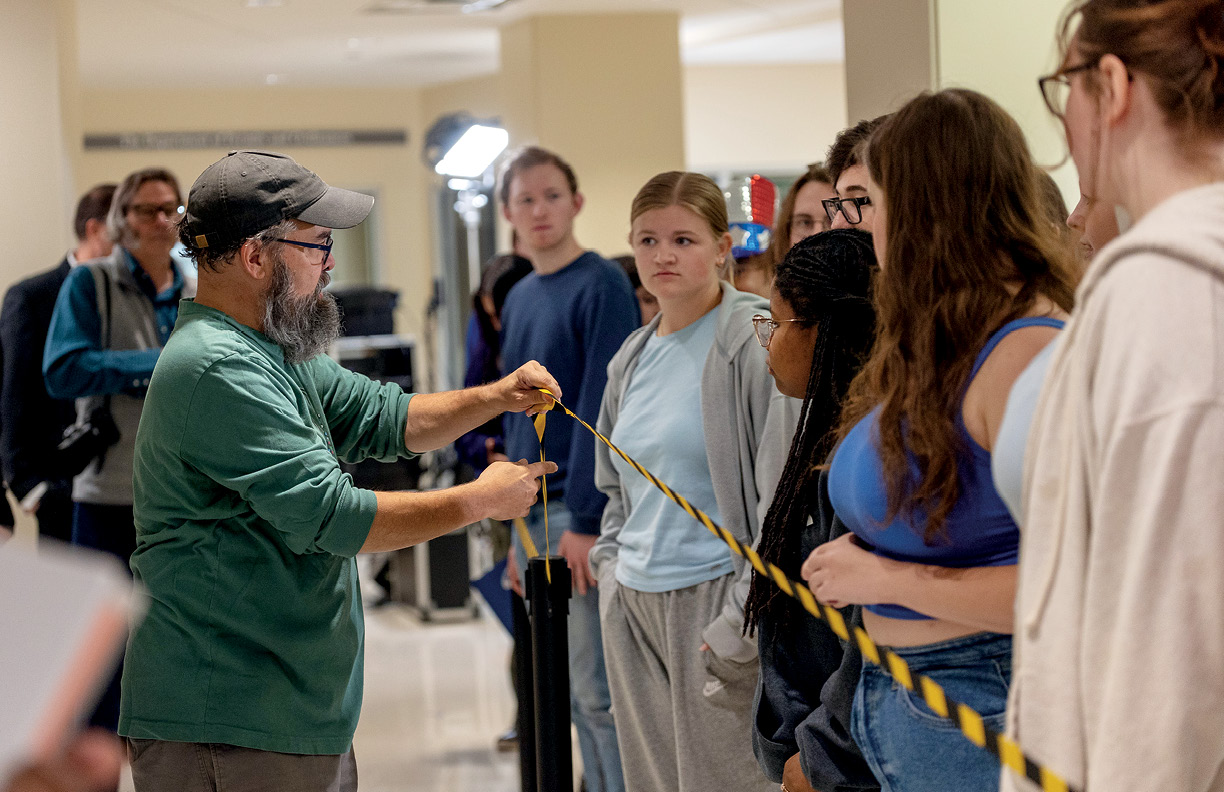
Scripps Professor Eric Williams, who is one of several leaders in OHIO360, shoots a training video for law enforcement officers in Schoonover Center. Officers will later experience the video in VR. Photo by Zoe Cranfil
Training Clients in Law Enforcement
OHIO360 grew out of an initiative in which OHIO’s Game Research and Immersive Design (GRID) Lab produced cine-VR content to be used as continual professional training modules for Ohio law enforcement departments. This content is now in its third season of production. The GRID Lab is outfitted with state-of-the-art hardware and software to create ultra-realistic experiences.
In one of the law enforcement training scenarios, a distressed teenage girl is standing on top of a bridge abutment; it looks like she is about to jump. Anyone wearing a VR headset to observe this scene will immediately look down – the perspective is nearly 50 feet above the water. A police officer is on the bridge, slowly approaching the girl. The officer employs techniques to de-escalate the situation, create trust and talk the girl down.
John Born vividly remembers the first time he donned a headset and took in this particular cine-VR experience. “It made my hands sweat,” he recalls, “It is as real as it gets without being there.”
And Born, BSJ ’85, MS ’92, has been there – he was a state highway patrol officer for 26 years, and he eventually served as director of the Ohio Department of Public Safety. Now a visiting assistant professor and executive in residence at the Voinovich School, Born was the one to make the initial connection between the GRID Lab and law enforcement agencies.
“It’s an extraordinarily effective training,” Born asserts. And trainees agree: Early surveys show that more than 80% say they prefer to be trained this way over traditional forms of training. Born appreciates the ability to frequently add new trainings because a professional can put on a headset, and 12-15 minutes later they have completed a session — no need to travel off site for a 2-hour tutorial.
New clients are coming on board, now that OHIO has proven itself in this leading-edge field. OHIO360 has contracted with the Ohio Department of Administrative Services to create experiences for employee training, and with the Forensic Nursing Network to develop experiences to co-train health care and law enforcement professionals using domestic violence scenarios.
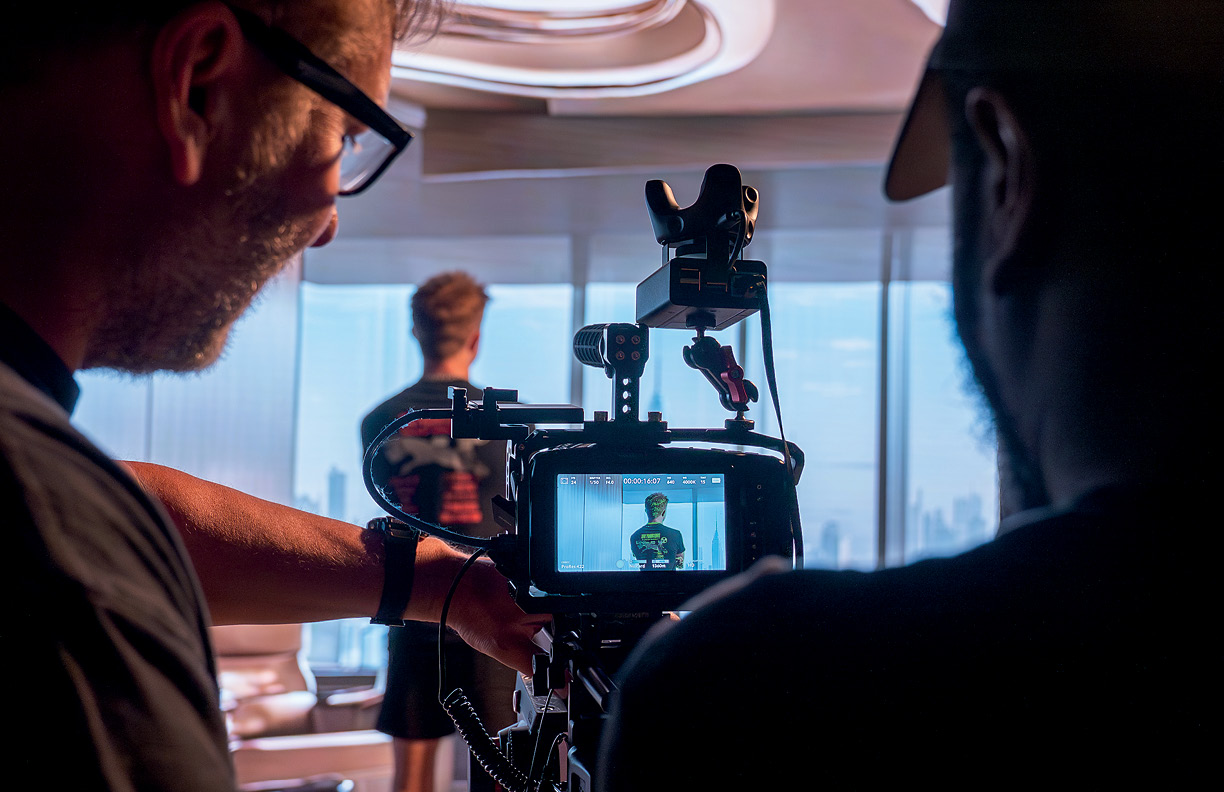
Associate Professor Brian Plow (left) uses the LED screen in Bob Lyon Studio to create a skyscraper background for a video. The well-anticipated screen will allow students to take their video production to a new level using innovative, virtual technology. Photo by Maria Gian, BSC '23
From Hollywood to Athens
Across College Green, another initiative at OHIO uses a shared technological ecosystem, but to a different end. Inside the RTV Building, students have access to a 21-by-12-foot LED wall capable of displaying massive, photorealistic digital environments in real time — no need to scout locations. The LED screen provides a background that seamlessly blends with a traditional foreground set and actors. At any given moment, the wall may display an underwater seascape, an alien spaceship — or Court Street, for that matter.
“We’re still in the business of movie magic,” says Brian Plow, associate professor of media arts and studies. While the LED wall is not immersive or 360 in nature, it still qualifies as cutting-edge cinematic technology.
“We were looking at, what can we do with this space? How can we be competitive?” Plow says, recalling the impetus for acquiring the wall in 2025. The space he is referring to is the former Studio C, renamed Bob Lyon Studio after the WOUB and longtime broadcasting alumnus. “We developed this idea for virtual production. It’s this integration of live action and virtual assets that happens live in camera.”
The studio, the LED screen and the technology that supports it are all part of the Scripps Digital Cinema Initiative, kickstarted with funding from Lyon, the Charles and Lucille King Family Foundation and the Scripps College of Communication. Today the college is home to two LED screens at a price tag of $575,000 — the Esports Arena in Scripps Hall boasts a smaller version used for live esports broadcasting.
The Esports Arena is a working production space where students apply what they learn by running multiple broadcasts each week.
“Esports jobs aren’t at the mouse and the keyboard, as we like to say; the jobs are going to be in the broadcast booth, behind the camera and doing announcing,” says Jeff Kuhn, director of esports.
The wall allows students to place announcers and broadcasters inside digital versions of the environments where players compete.
The larger LED wall, along with two advanced digital cinema cameras and computing technology in the Advanced Visualization Lab on the third floor, changes filmmaking by replacing traditional green-screen techniques with real-time digital environments. Instead of actors pretending to stand in a herd of wild animals or a postapocalyptic city while editors add backgrounds months later, filmmakers can immediately see the final environment through the camera. Plow describes this as more than just a green screen on steroids: it’s flipping the production pipeline. Instead of creating worlds in post-production, students create worlds in pre-production in the Advanced Visualization Lab.
This technology is increasingly common throughout the entertainment and media industries. Plow points to its use in large Hollywood studios for film and television, but also in corporate media studios, professional athletics and esports.
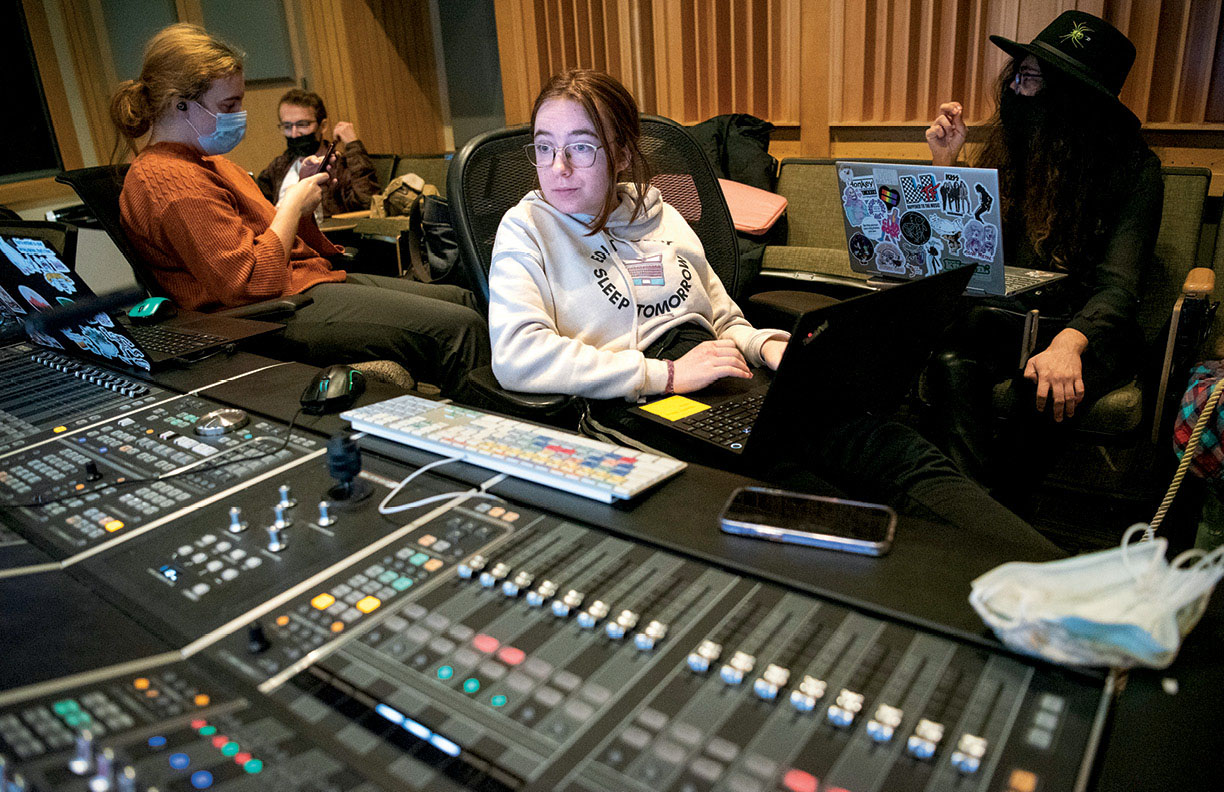
Meg Sharp edits sequences of a video on the morning of the deadline for Scripps’ 20th annual 48-Hour Shootout. Students are challenged to write, shoot and edit a short film in just those two days. Photo by Rich-Joseph Facun, BSVC '01
Central to the college’s mission, the wall is preparing students for jobs using this latest technology. Meg Sharp, BSMAS ’24, apprenticed with Plow in 2022. From her office in the GRID Lab, she learned the software Unreal Engine and made recommendations for how to incorporate virtual production into the curriculum.
“The fact that … it was a paid apprenticeship was a big deal,” Sharp says, “I was learning the cutting-edge tools used in the industry. That changed the trajectory of what I do.”
That trajectory included an internship at a virtual production studio when Sharp completed the OHIO-in-LA Program, and now a job as a creative technician at OHD Studios, a full-service video production facility in Columbus.
She credits her early success in the field to the apprenticeship with Plow. “It was a lot of learning and problem solving and creative technical thinking and trial and error. And those are all skills that I use every day at my job,” Sharp says.
Back in Athens, students are developing these technical and professional skills using the LED wall for a wide range of projects: WOUB’s Gridiron Glory used the space to create a custom virtual media-day set for high school football players, OHIO Athletics has filmed hype videos on the set, Brick City Records shoots music videos there and the student ad agency NEXT produced promotional content for the global tech corporation Siemens.
In short, the LED wall represents a major investment by the University to give students the opportunity to create content on par with what Hollywood studios create, using the same tools.
“It moved us into the current ‘state of the art’ in media production,” Plow says. “The more we can bring people together over an exciting opportunity, the more we model our educational ecosystem after what happens in the industries we send our students out into.”