
Fall 2026 Edition
Alumni & Friends Magazine
Touring OHIO’s Athens Campus Transformation
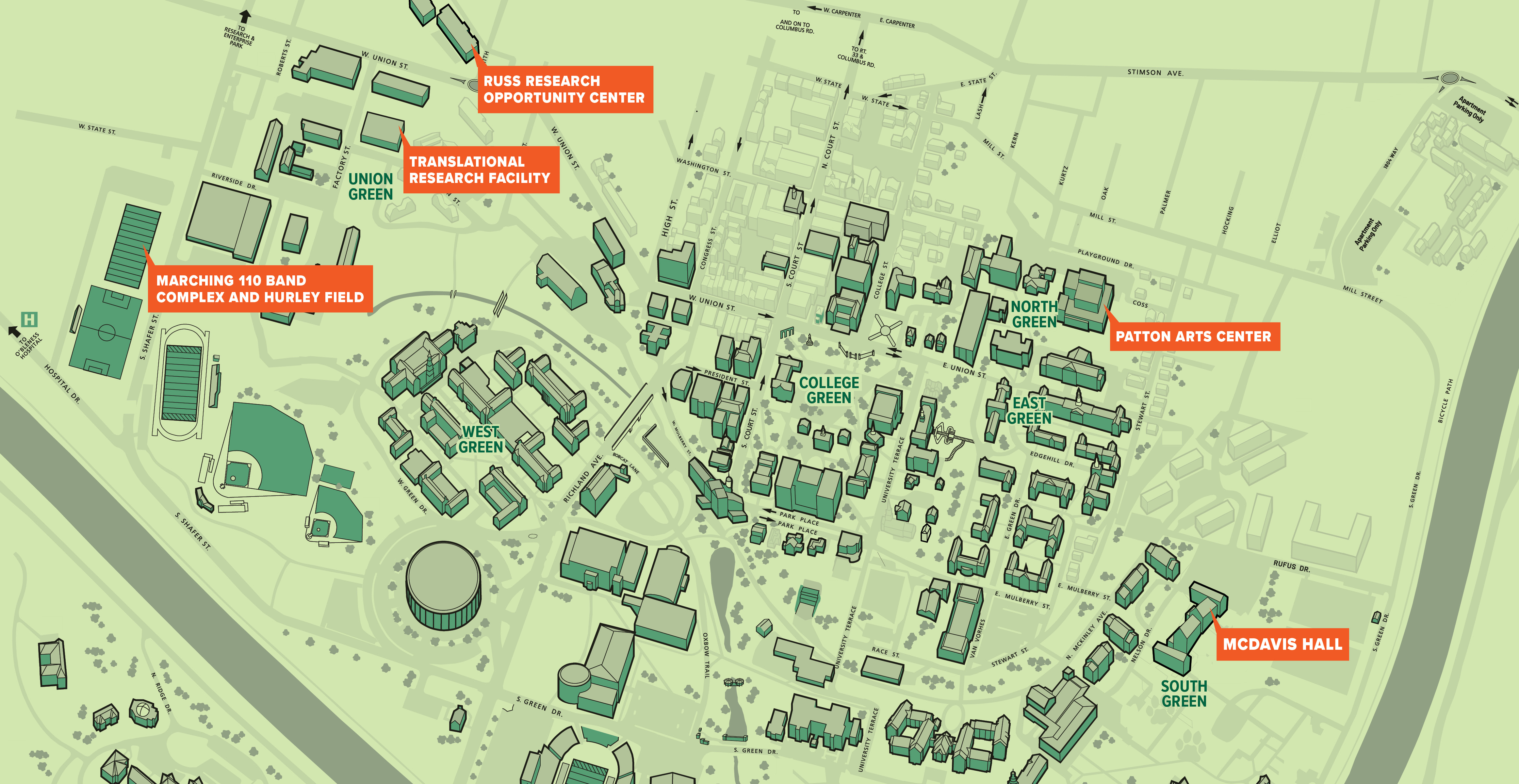
For a preview of your next trip to campus, or a glimpse from your corner of the world, take a tour with us to see major construction projects recently completed or underway across the Athens campus.
Robin Oliver, Vice President for University Communications and Marketing | November 23, 2026
Share:
As you drive along South Green Drive, past Peden Stadium and the Ohio University Golf and Tennis Center, the scenes are familiar at first. Then, off to the left, across the greenspace once used by the Marching 110 for occasional rehearsals, steps rise to a wide patio and a wall of glass windows flanked by brick on either side. Beckoning students to relax, oversized outdoor furniture offers space to sit and enjoy Athens in the fall. Inside, students can enjoy ping-pong or sit on cozy couches at OHIO’s newest residence hall. McDavis Hall opened its doors just in time for the entering Fall 2026 class.
With architecture designed to complement buildings on South and East Greens, McDavis fits so well in the space that it is almost difficult to imagine the view from South Green Drive before this development. Only small patches of red earth where grass has not yet established itself give away the newness of the building.
McDavis Hall is one of several major construction projects recently finished or under way on OHIO’s Athens campus that are together transforming various corners of campus and elevating living and learning space for future generations of Bobcats. As a preview of your next trip to campus or a glimpse into Athens today, take a tour with us.
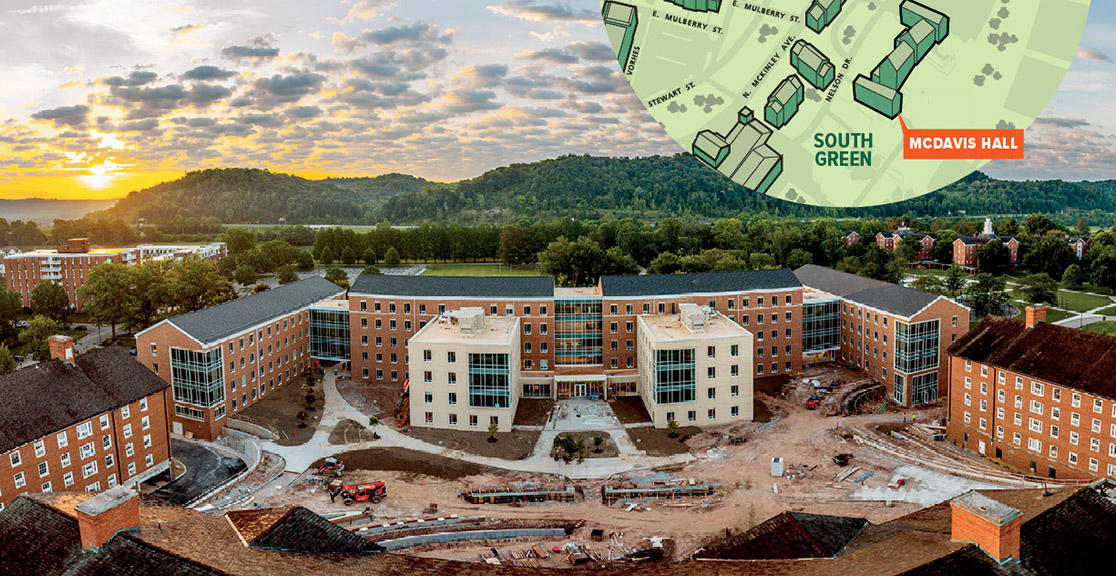
Overhead view of late-stage construction on McDavis Hall as crews finalize exterior work. Photo by Ben Wirtz Siegel, BSVC '02
Next Stop: The Patton Center for Arts Education
Continue along South Green Drive past the intramural fields, until it turns left and becomes Mill Street. Then take your first left on Stewart Street and your first right on Union. You’ll want to circle the parking lot across from Jefferson and adjacent to Patton Hall to see the framework coming together for the Patton Center for Arts Education in the Chaddock + Morrow College of Fine Arts, planned to open in 2027.
Serving as the centerpiece for a total reimagining of the academic space serving students in the arts, the Patton Center will feature an art gallery and a 400-seat theater that will be the future home to countless performances, bringing cultural opportunities to the region and delivering essential experience to students in theater, music, dance and more.
The Patton Center will provide a major upgrade from Baker Theater in Kantner Hall and the Forum Theater in the RTV building, in size and technological capability. The new state-of-the-art theater is situated adjacent to other arts classroom facilities to drive student participation and collaboration, including the newly renovated and renamed Levy Ceramic Studio.
The addition is part of a larger reenvisioning of art, design and performance space that also includes technology improvements for graphic design students and more.
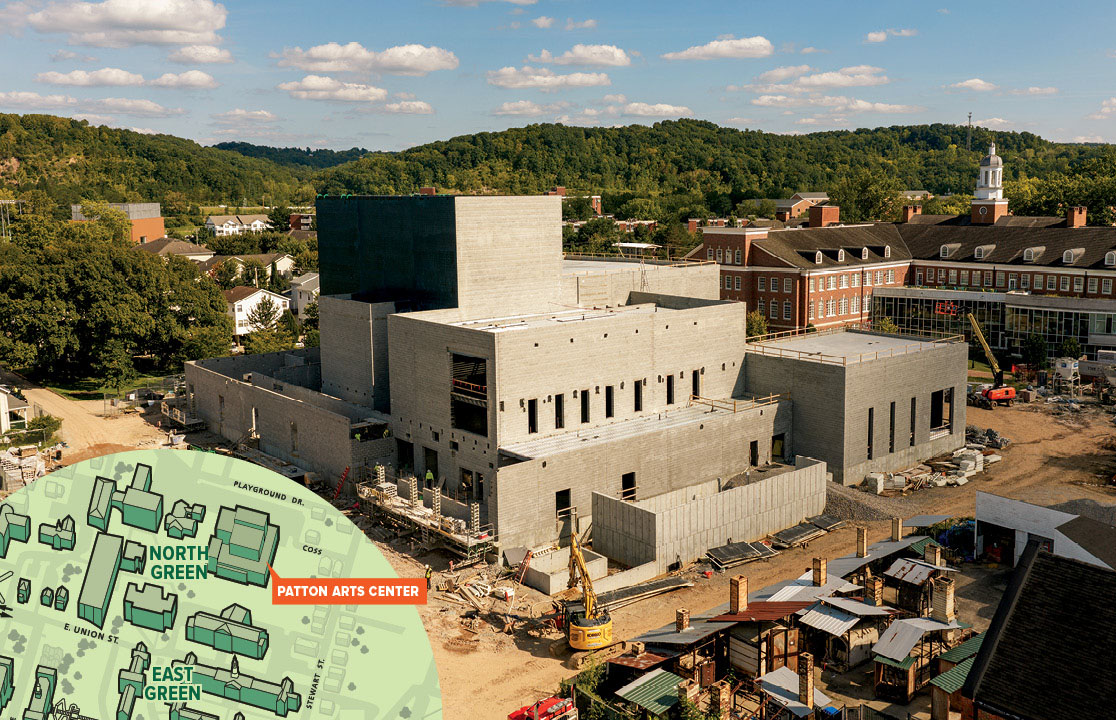
Active construction on North Green, building the framework for the Patton Center for Arts Education. Photo by Ben Wirtz Siegel, BSVC '02
Union Green: New Medical, Biomedical & Engineering Research Facilities
Continue along Union Street past College Green. You’ll have to make the turn to avoid the one-way section of Union Street, so feel free to stop at your favorite Uptown haunt. Then, continue along West Union past Union Street Diner. If it has been a while since your last visit to Athens, there’s a lot to see here.
As you approach the Factory Street intersection, off to your right is the Russ Research Opportunity Center. Opened in 2025, this new facility has quickly become known on campus as “the RROC” (pronounced “rock”). Over the past year, the Russ College of Engineering and Technology has consolidated research labs across a variety of fields into this new and improved facility, bringing technology and research assets together so that these can be more easily shared across research projects.
The Union Street location of the RROC also positions engineering research adjacent to the Heritage College of Medicine for possible biomedical collaboration as well as interdisciplinary applied research projects.
Later this fall, OHIO will also open the doors to the $75-million Heritage Translational Research Facility just across Factory Street from the Heritage College’s primary classroom building and a short walk from
the RROC.
For those less familiar with research terminology, the word “translational” describes research that translates basic science discoveries into treatments, devices and practices that improve public care and population health.
In addition to serving the Heritage College, the facility will support several established, health-related institutes at OHIO including the Ohio Musculoskeletal and Neurological Institute (OMNI), the Diabetes Institute, the Institute for Molecular Medicine and Aging and the Appalachian Institute to Advance Health Equity Science.
The Translational Research Facility includes several uniquely constructed lab spaces for discipline-specific work, including a state-of-the-art vivarium, a monitored facility for animal housing and care, that was funded in part by a rare $8 million capital grant from the National Institutes of Health. This significant 2024 NIH award resulted in the Heritage College receiving more NIH funding than any other osteopathic medical school in the nation in 2024.
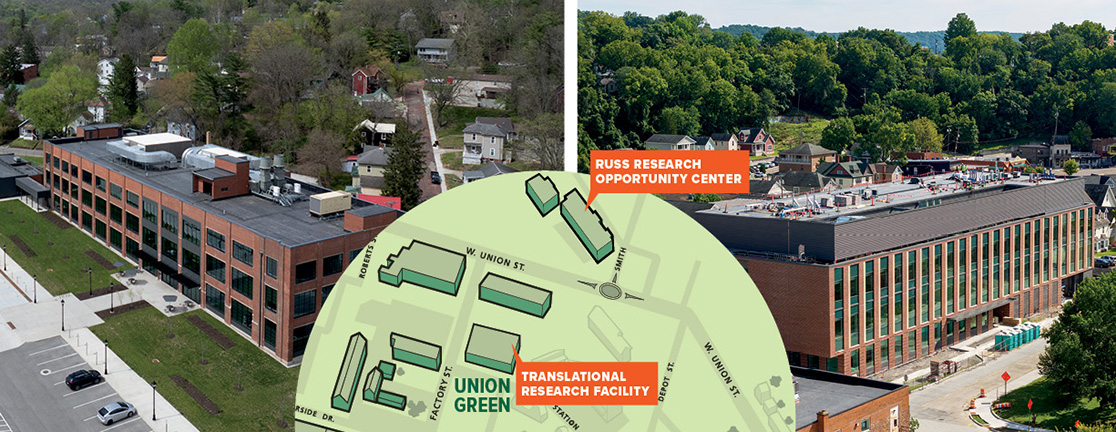
[LEFT] Overhead view of the Russ Research Opportunity Center one year after completion. [RIGHT] Drone perspective of Heritage Translational Research Facility in the final stages of construction. Photo by Ben Wirtz Siegel, BSVC '02
A New Home for the Marching 110
Once you pass this new and growing research corridor, you arrive at South Shafer Street. Take a left; just ahead on your right you can’t miss the fresh green turf of the new Marching 110 Band Complex and Hurley Field. In the band’s 100-plus-year history, this fall is the first time the Marching 110 has had a designated practice facility on campus. In previous years, they’ve practiced in various locations across campus, sometimes accepting less-than-ideal conditions.
The new complex features a dedicated practice field with durable turf as well as the Kanold Family Pavillion, which offers shade, instrument storage and restroom facilities for members of the Marching 110 —which was recently named the best college marching band in the nation by USA Today (see page 6).
During home game days this fall, the Marching 110 will march along South Shafer Street from the new practice field to Peden Stadium, bringing us back to the beginning of our tour of recent and ongoing campus transformation.
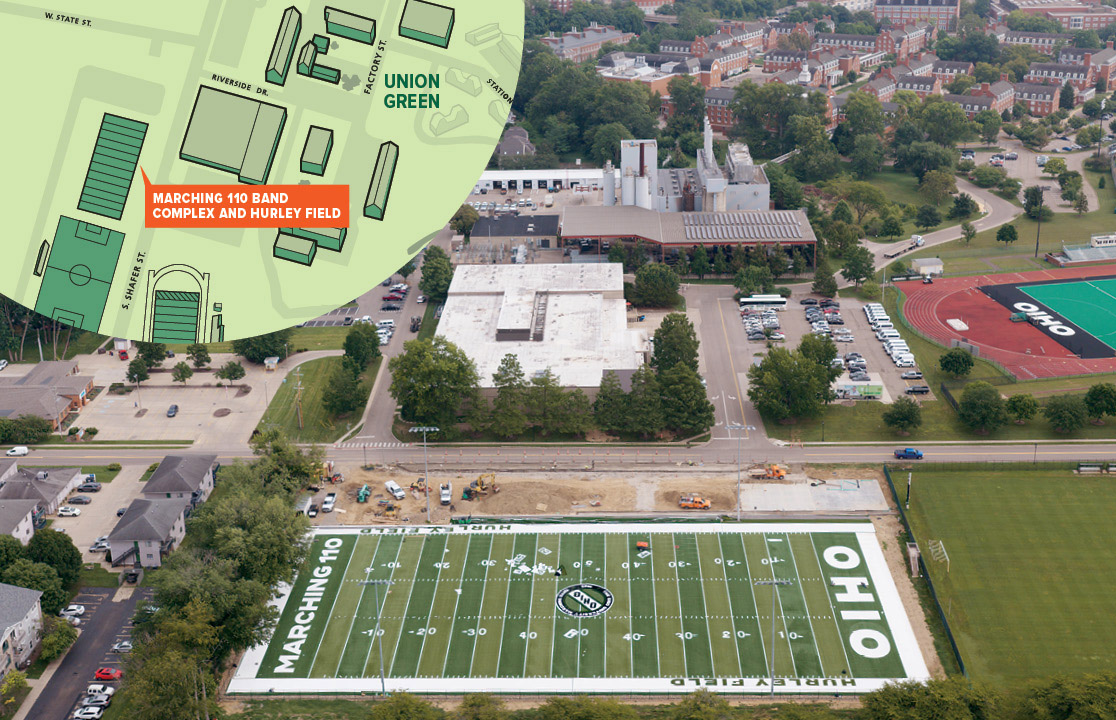
Aerial view of Hurley Field and the Marching 110 Band Complex in the late stages of construction. Photo by Ben Wirtz Siegel, BSVC '02
Campus Transformations Made Possible Through Bobcat Generosity
These projects are funded through many types of philanthropic support: estate gifts, project-based cash gifts, multi-year corporate pledges and smaller gifts that add up to make a real difference.
In the Chaddock+Morrow College of Fine Arts, the Patton Center for Arts Education was made possible through an estate gift from Violet Patton and significantly supported by the college naming gift from Jeffery Chaddock and Mark Morrow. Just next door, a gift from Dave and Cathy Levy provided support for renovations to studio space in ceramics, now named the Levy Ceramics Studio.
In the Union Street corridor, the Russ Research Opportunity Center was supported with funds from the Fritz J. and Dolores H. Russ estate gift, and the Heritage Translational Research Center was supported with a significant gift from the Osteopathic Heritage Foundation.
Marching 110 alumni Shawn and Tracey Hurley made a foundational gift to fund the practice field, and band parent June Konold enabled the expansion of the project to include the Konold Family Pavilion and Patio. The band complex was primarily funded through private gifts.
“These are more than new buildings and new facilities. Together, these projects are transforming our student experience and expanding our research capabilities, and each of these projects was made possible in whole or in part by philanthropic support,” says Greg Simmons, vice president for advancement and CEO of the Ohio University Foundation. “At a time when many universities are pausing projects, we have been able to continue important development and elevate our student experience thanks to our donors and partners.”