Image
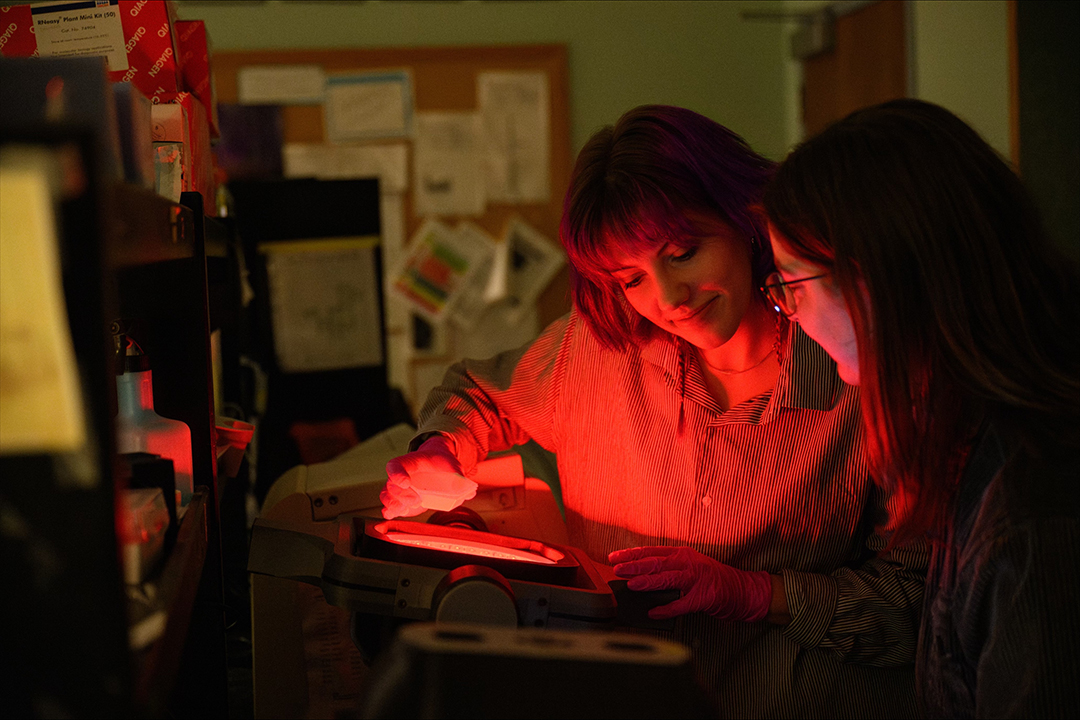
Three recent Ohio University graduates designed an experiment that will be launched into space and sent to the International Space Station as soon as mid-May. Lara Fogwell and Cat Gavin, along with collaborator Jake Magula, are studying the effects of microgravity on plants, research that may also prove extremely valuable for the future of space farming.
Alex Semancik | May 7, 2026
Share:
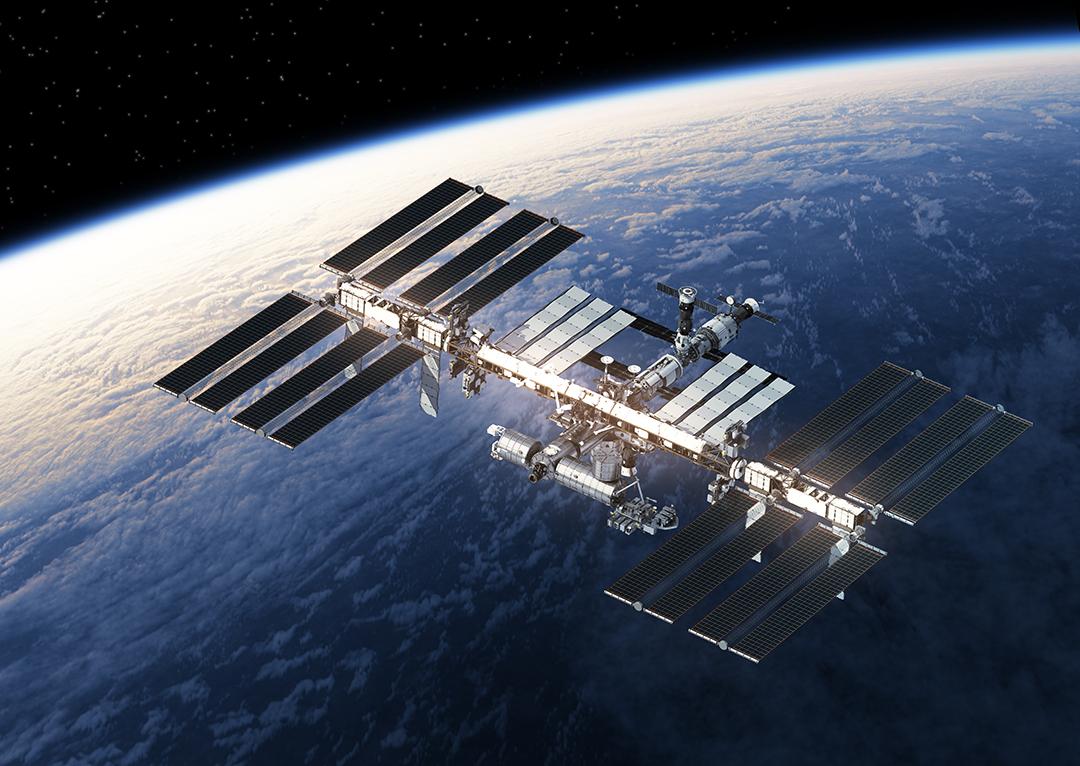
Three recent Ohio University graduates have done something very few people will ever achieve—send something to space. As early as Tuesday, May 12, their experiment studying the viability of growing plants in space will be sent to the International Space Station (ISS) via SpaceX’s 34th Commercial Resupply Services mission to the orbital laboratory for NASA. Beyond being an impressive accolade as part of the alumni’s undergraduate careers, the research may also prove extremely valuable for the future of space farming.
The path to sending something to the cosmos was not an easy one but Co-Principal Investigators Lara Fogwell and Cat Gavin, along with collaborator Jake Magula were up to the task. To have their project go to space they first had to be selected by the national Student Spaceflight Experiments Program (SSEP). The program gives students the ability to design and propose real microgravity experiments to fly in low Earth orbit.
“Effect of Microgravity on Growth of Watercress: a Promising Space Food,” ended up being selected for flight in December of 2024, and the recent Ohio University alumni are counting the days until launch with great anticipation.
“I’m very excited,” said Fogwell. “I’ve been looking forward to this for years now at this point. I always say it’s going to be my fun fact—I’ve sent something up to space, pretty cool.”
All three scientists were undergraduate students at Ohio University when they began this research project three years ago. Fogwell graduated just days ago at OHIO’s May 2026 Commencement ceremony with a degree in chemical engineering, while Gavin graduated a year earlier in the environmental and plant biology program. Magula, who was only involved with the first year of experimentation, graduated in May 2024 with a degree in environmental and plant biology.
Much of the experiment revolves around watercress, a nutritious, peppery leafy green that was recently named the healthiest vegetable by the Centers for Disease Control and Prevention. Watercress is a fully aquatic plant with simple requirements for growth making it an ideal plant for space travel where things like room and weight are extremely limited.
The goal of the SSEP project is to see if spaceflight has an impact on plant growth. Watercress seeds will be kept in three different conditions: spaceflight (aboard the ISS to test the impact of microgravity), Earth gravity (as a control) and a clinostat (which simulates the effects of microgravity). The germination rates and starch content will then be compared. Fogwell and Gavin hypothesize that germination success rates of watercress in space will be comparable to Earth gravity and that growth rates will be even higher.
“We’re hoping based on previous experiments done by others in simulated microgravity, that this will be a viable solution for growing food in space,” said Gavin. “The hope is that the seeds will grow as well or better in space. Watercress is also a basic aquatic plant so our findings should be able to be applied to a larger variety of plants. They’re a basic plant at their core, so this will be a good basis for more potential food growth in space.”
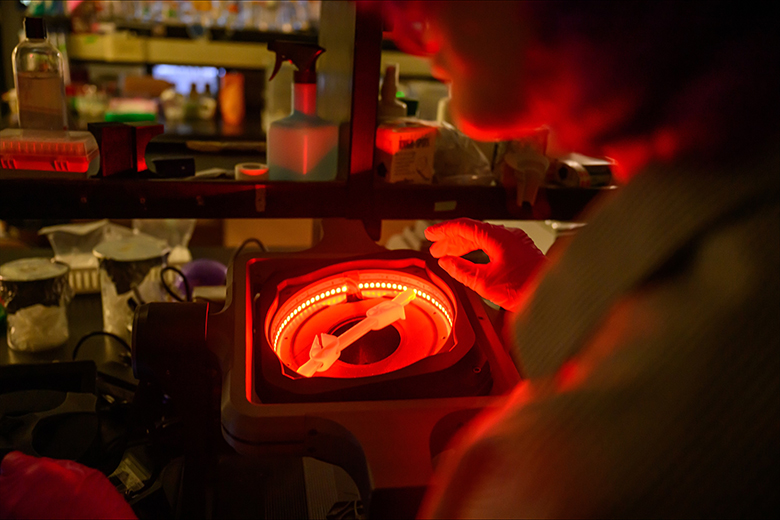
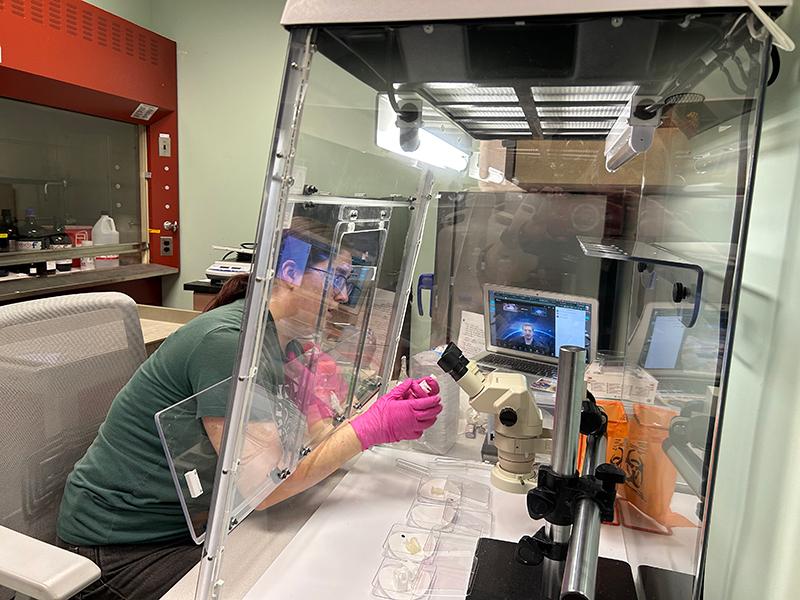
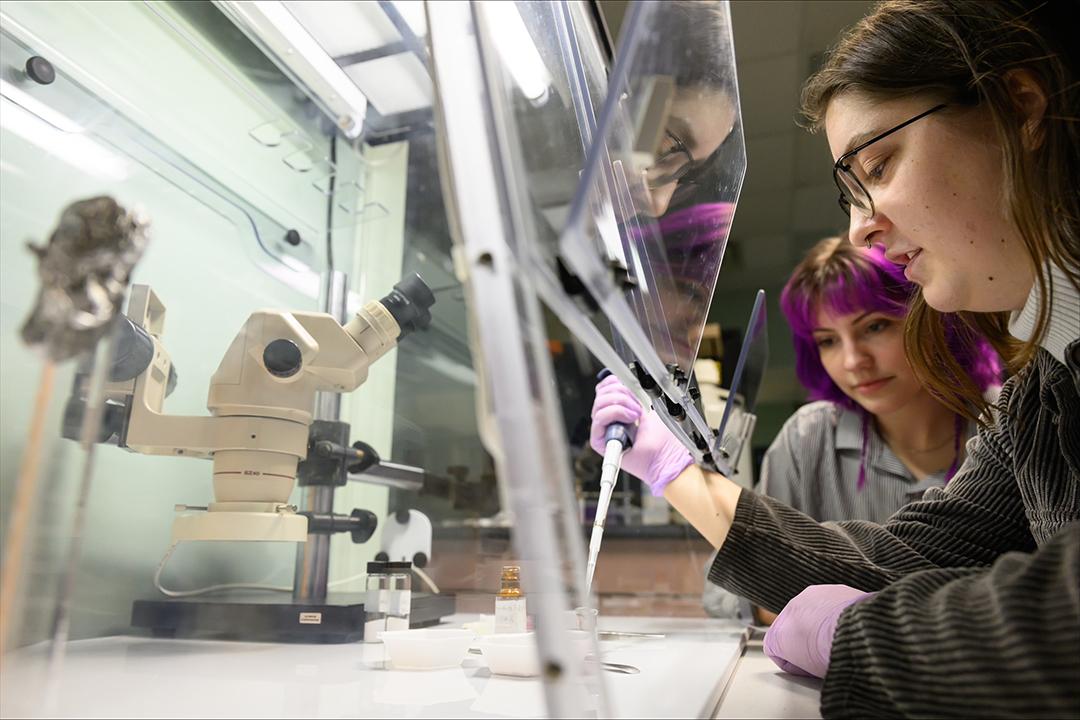
Gavin and Fogwell work with an FME mini-lab in an Ohio University laboratory.
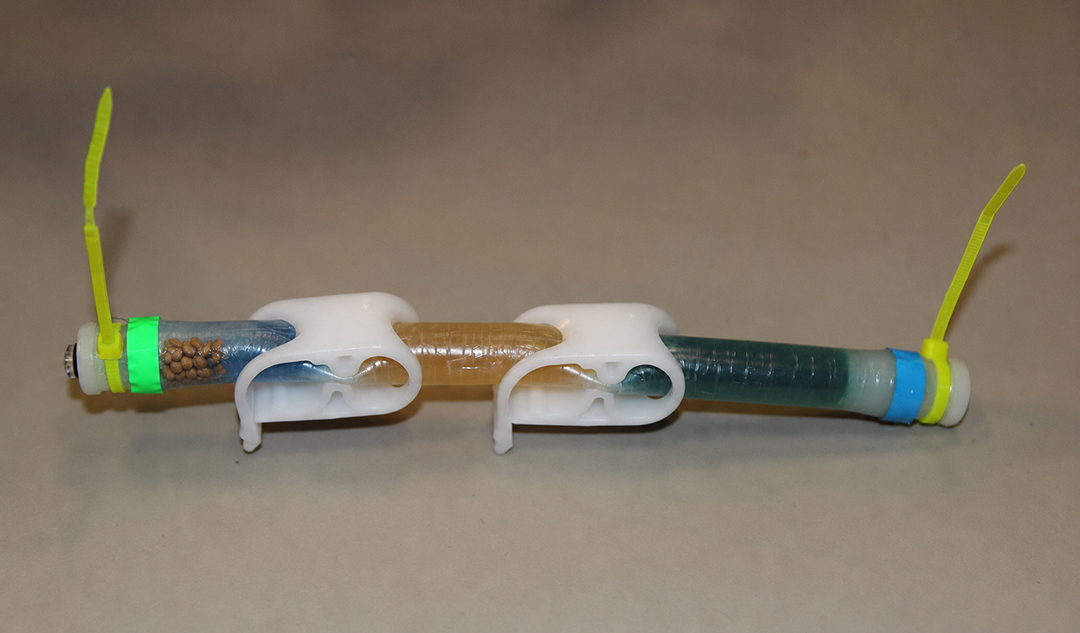
An example FME mini-lab (not used in this experiment). The three separate chambers and two clamps are clearly visible.
Dry, inactive watercress seeds will be placed in Fluids Mixing Enclosure (FME) mini-laboratories—plastic tubes with three chambers and two clamps to separate the chambers. The first chamber will contain the seeds themselves; the second chamber will contain water to germinate the seeds once they are in space; and the third chamber contains a fixative chemical to stop plant growth before the experiment returns to earth so that results are isolated to when the plants were in microgravity.
Astronauts living aboard the ISS will be responsible for managing the experiment and releasing the clamps that separate the three volumes in the different chambers of the FME mini-labs.
“We get to tell the astronauts what to do, which is mostly opening and closing the clamps and then shaking it,” emphasized Fogwell. “So, we have those two clamps separating the three volumes and the astronauts are going to open one and then the other and shake it around while it’s up there.”
Under the guidance of Distinguished Professor Sarah Wyatt, Ph.D., the recent alumni are also hoping their research is circulated through a publication where other scientists will be able to build off of their findings. As an internationally renowned leader in the field of plant responses to gravity, Wyatt is an ideal mentor in this space. Her research includes multiple collaborations with NASA, with five experiments conducted aboard the ISS. In 2023, she was also selected as one of just 18 scientists nationwide to help develop a 10-year research roadmap supporting human exploration of the moon and Mars.
“Space farming is becoming a bigger issue now that we’re starting to think about going to the moon and going to mars,” said Wyatt. “So, this experiment is right in line with how we provide food and life support in general. This information can be very useful especially with the clinostat simulation.”
Wyatt was also the one responsible for bringing the Student Spaceflight Experiment Program (SSEP) to Ohio University, something her students are forever grateful for. This most recent project created by Fogwell, Gavin and Magula will be the second SSEP experiment to fly.
“We’re definitely very grateful for the opportunity of the program itself and all the work Dr. Wyatt did to bring it here,” said Fogwell.
As a chemical engineer, Fogwell did not necessarily expect to be working with plants, but her unique perspective meshed extremely well with Gavin’s familiarity with plant biology in a complementary way that benefited the experiment.
“I think it was definitely helpful,” said Gavin. “I gave all the chemical stuff to Lara, and I took care of the plant questions.”
The interdisciplinary collaboration meant that both researchers were able to grow as scientists and learn more about how to successfully design an experiment.
“We also all learned a lot from each other,” Fogwell added. “I’m not a plant biologist, but I volunteered myself to do anything for the experiment. Plants are cool, I’ve gotten a lot more into it since starting, but I was a bit out of my element to begin with the plant biology.”
As for getting the project into orbit, space travel can be quite an unpredictable venture. A lot can go wrong and launch delays can be quite common. The Ohio University SSEP study of watercress in space was originally supposed to launch last year but was delayed due to a resupply rocket explosion that occurred right before.
“That’s the thing with space flight, is a lot of times the rocket doesn’t even leave the ground on the day it was originally supposed to, because there might be one little thing that doesn’t seem right and they delay the whole thing,” said Gavin.
Wyatt said that the experience of dealing with delays is par for the course with space travel. Her first experiment that flew took seven attempts before it was successfully launched.
But the alumni and Wyatt are both hoping their experiment’s time to shine is soon on the “no earlier than” May 12 date.
“When we figure out what time it's going to fly, we're all going to be on our TVs watching it launch,” emphasized Wyatt. “There’s nothing better than watching a launch and knowing that your experiment is on that ship. It’s just an amazing situation, and to be able to share that with the students in a realistic way is my favorite part. To see people come and be excited about what they’re doing, to be able to take them to the meeting and show them Kennedy Space Center. It means a lot to me. The [SSEP] program gives us that opportunity.”
About SSEP: The Student Spaceflight Experiments Program (SSEP) is a program through the National Center for Earth and Space Science Education (NCESSE) in the U.S. and the Arthur C. Clarke Institute for Space Education, internationally. SSEP Missions 1-20 to the International Space Station were enabled through a strategic partnership with Nanoracks, LLC, which worked with NASA under a Space Act Agreement as part of the utilization of the International Space Station as a National Laboratory. SSEP Missions 21 and 22 are enabled through a strategic collaboration with Rhodium Scientific, America's first commercial space biotech company and mission Spaceflight Implementation Partner, working with NASA through a CASIS Agreement to utilize its facilities aboard the International Space Station.