
Spring 2026 Edition
Alumni & Friends Magazine
Last Word with DeQuindre Hughes
A recent addition to OHIO’s Department of Counseling and Higher Education faculty brings an invigorating perspective to the classroom to teach the next generation of counselors.
Julia Weber, BS ’25, MAA ’26 | Photo by Ben Wirtz Siegel BSVC ’02 | April 21, 2026
Share:
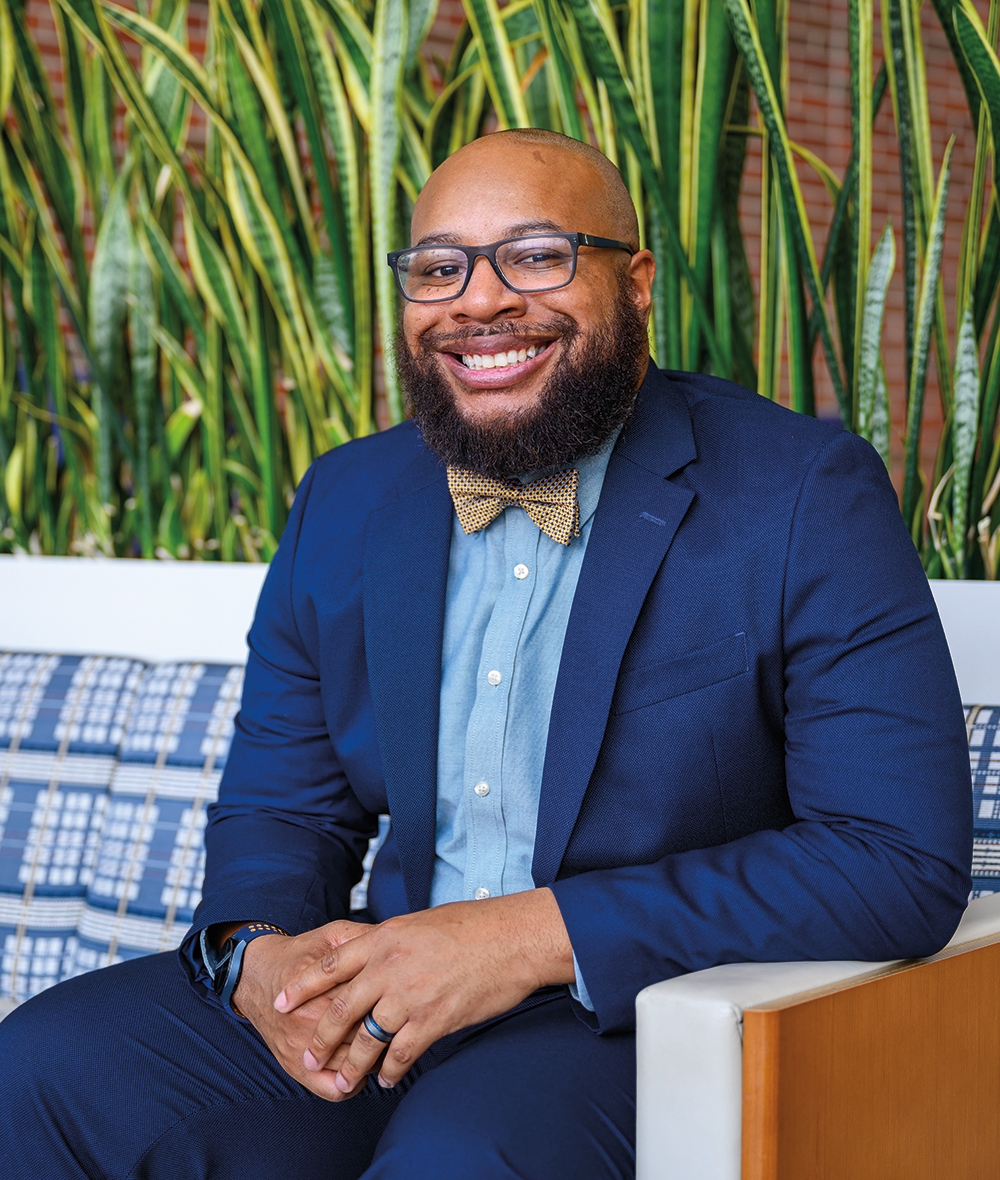
DeQuindre Hughes is an assistant professor of instruction in OHIO’s Department of Counseling and Higher Education. Having recently been selected as a 2025 Emerging Leader by the North Central Association for Counselor Education and Supervision, Hughes foregrounds an equity-centered intersectional practice in both pedagogy and counseling, aspiring to ensure counseling clients and students alike feel seen, heard and empowered.
You were recently chosen as an NCACES Emerging Leader. What is the ACES and what does this mean for you professionally?
The Association for Counselor Education and Supervision is setting the trend for counselors and what we do in terms of teaching and research. It’s an honor and a responsibility to be an Emerging Leader. Being selected, they must have seen that I’m trying to be equity-centered and trauma-informed both in my pedagogy and in my counselor training. This is an opportunity for me to network with NCACES and to grow with leaders in counselor education in the area, allowing me to collaborate with them in different ways. There’s also responsibility that comes with that. We do 50 hours of service over the course of a year, we attend the NCACES conference that will be held next year and then we also work on different committees. I’m part of the NCACES government committee as well outside of this, but as an Emerging Leader, one of my responsibilities is being a part of the organization’s awards committee.
How does this award advance both your pedagogy and your clinical training through these professional development opportunities?
I graduated from The Ohio State University in August 2024, so it’s not that long ago that I graduated. This is giving me the opportunity to connect with those who have been in the field who are excellent writers and mentors, and who understand what’s going on at the local and state level, but also the national and international level too. It’s a great opportunity to learn a lot from them. In terms of the service component of the award, counseling is already a very voluntary type of profession: what we do is we give back. Being an Emerging Leader enhances that and allows for more connection with others who are also recent doctoral students or who are also trying to find jobs as a professor; I think those are some of the best things about that. I review manuscripts and proposals for two journals and previously, I did proposal reviews for different conferences. NCACES allows me to do something I already have similar experiences in and it is further strengthening me because I want to continue being in this organization and hopefully one day I can be on those committees where I have the experience.
Before you came to OHIO, you worked as an elementary school counselor. How did that professional experience shape your approach to teaching?
Being able to break something down for someone who is in kindergarten, preschool, first grade, third grade allows me to shape my teaching. How do I make sure I’m giving these skills and this knowledge but also making it creative for students and making it fun? One thing I took from being an elementary school counselor is being patient, being playful and creative. It doesn’t matter what age we are, we want creativity, we want to have fun. When we have fun, we learn things more deeply, especially in a setting where we’re learning about topics that can be very complex.
How did you know that you wanted to go into counseling?
I originally wanted to go into social work; I actually wanted to work in substance abuse disorders. The program I was in actually ended up going into geriatric social work and I wanted to work with children and adolescents. I was like ‘That came out of nowhere.’ The decision was focused on where I could have the most impact. I still wanted to work with this population, and that’s where I fell into school counseling. I was already interested in counseling and I had a psychology background; I thought ‘Well, where is the most impact?’
What are some of your favorite hobbies?
I really enjoy going to aquariums and museums. My wife and I travel as much as we can. Last year, we saw free concerts. Columbus Commons hosts free concerts; you have to get tickets for it, but we saw a lot of musicians last year. We saw Hozier, Glass Animals, Avril Lavigne, Simple Plan, The Girlfriends, Boyz II Men, we saw a number of people last year. We try to do those little adventures and find ways to have fun. One hobby I really enjoy is running. I fell in love with it when I was in my master’s program in Chattanooga, Tennessee, but it was in the mountains, so it was basically running uphill. It was really enjoyable and it allows me to both exercise and have a hobby that’s relaxing and lets me think about things and get away from things.
What is your approach to teaching students and future counselors?
One thing I really like to focus on is intersectionality; I want to look at all aspects of your identity in the classroom. I also focus on strength-based approaches and being people-aware; I want to affirm what students are doing well, guide them in areas where they can grow with clear, actionable suggestions and really try to focus on making sure they know they are in the program for a reason and trying to affirm them in that sense while also leaving room for self-growth.
Do you have a favorite spot on campus?
This is my first year, so I’ve only been to so many parts of campus. So far, Patton Hall. That’s where most of the counseling teaching happens, and that’s where I can find pretty much all of the faculty members in the program. A lot of conversations happen there — not just teaching, but honest conversations.
What is your favorite part of working with students?
Really, witnessing their growth more than anything. I always tell my students ‘I want you to be more confident and competent counselors.’ Someone who is confident in their abilities, confident in their knowledge and skills, and is competent — whether it is in multicultural counseling, in using certain models and theories, whatever it may be, I want them to leave stronger at the end of the day. They’re here for a reason; they already have all these skills, we’re just refining them. My favorite part is seeing their growth because my purpose of being here as a professor is teaching them. I'm hoping that they go to these communities, to these schools, and make a difference. I want them to go out there and take down these systems that harm and hinder opportunities for the populations they are working with.
What’s one thing that you want to share with readers about counseling that they might not already know?
I think that there is a stigma around counseling, that it’s for certain people — those who have mental health issues or things like that. Anyone and everyone can benefit from counseling. At the core of counseling, it’s really about empowerment and resilience, allowing people to share their voices, to feel heard and seen, to work on goals that are particular to that person. Counseling is about meaningful change and resilience and recognizing an individual’s strengths more than talking about trauma and mental health issues. Those are a part of those conversations, but they aren’t the only part of counseling; it is more than just fixing problems. Counselors don’t fix things, but we’re here to help individuals grow, see who they are and want to be and determine how they reach that for themselves.