
Spring 2026 Edition
Alumni & Friends Magazine
Made in the USA: Stitching Together a Manufacturing Revival
Ohio University’s Voinovich School of Leadership and Public Service develops award-winning, research-based solutions to challenges facing communities, the economy and the environment. The goal: give business and community leaders the resources they need to advance economic development, improve infrastructure, solve environmental problems and improve the health and overall well-being of everyone in Ohio. In a single year, the school served more than 9,000 businesses, forged 13 state agency partnerships and advanced over 220 community projects across Ohio. What follows is one such effort.
Anna Jinja Mather and Sarah Filipiak BSJ ’01, BS ’23 | April 23, 2026
Share:
The United States rarely makes its own clothes anymore. Of the roughly 460,000 apparel manufacturing facilities operating worldwide, fewer than 6,000—well under two percent—are located in the U.S., according to the Bureau of Labor Statistics and industry estimates.
Decades of offshoring gutted the domestic garment industry, and the infrastructure, expertise and workforce that once sustained it largely vanished with it. Reviving that work in Appalachian Ohio is the kind of connective challenge that Ohio University’s Voinovich School of Leadership and Public Service has made its specialty.
Now, a once-abandoned church in Buchtel, Ohio, hums with new life as the Hocking Hills Garment Center, an industrial sewing training and apparel manufacturing organization, works to revitalize American manufacturing—with critical support from the Voinovich School.
The center, which opened in 2024, produces knit and woven apparel for brands that value quality, craftsmanship and domestic production.
Reviving garment manufacturing in the United States starting in a rural county is a daring idea. Doing so with limited infrastructure and no garment industry to loop into is a daunting challenge.
Propelling founder Betsy Franjola from aspiration to manifestation was some well-timed guidance from the Voinovich School’s Impact Enterprise Team. The team offers one-on-one professional business coaching to mission-driven for-profits, nonprofits, and entrepreneurs. Franjola, an Athens native, brings more than 25 years of fashion industry experience, including stints at Juicy Couture and Abercrombie & Fitch, plus her own ventures, BFF Studio, Inc. and PREFACE. But launching the Hocking Hills Garment Center required something new: strategic partnerships, grant funding and business planning expertise at a scale she’d never needed before.
Much of economic development is behind-the-scenes work (part policy research, part community organizing, part coaching startups). The Voinovich School stands out in its successful shepherding of partners and projects that meaningfully improve life for Ohioans, like the Raccoon Creek restoration, the Portsfuture program and expanding the broadband workforce.
“The Voinovich School is committed to rigorous, data-driven work that tackles Ohio’s most pressing challenges, from housing and economic development to watershed restoration, public health, small business growth and infrastructure,” says Dean Tracy Plouck. “Through close collaboration with partners and communities across Ohio, we turn research into practical solutions that improve lives.”
Franjola’s vision for a garment center was a natural fit for the school’s Impact Enterprise Team, which boasts $63+ million in grants, investments, loans and client revenue as a result of services since it was established in 2017.
Beginning in 2022, the team helped map the garment center’s partnerships and business plan, assistance that a startup in the region can’t always easily find on its own. Four years later, that former sanctuary houses rows of industrial sewing machines, cutting tables and space for worker training: a physical testament to Franjola’s vision to bring garment manufacturing to Southeast Ohio.
“We’re not here to compete with overseas,” Franjola asserts. “And we honestly don’t want to,” she explains. Instead, the center is seeking brands focused on quality and sustainability, with partners willing to invest in American manufacturing despite higher costs.
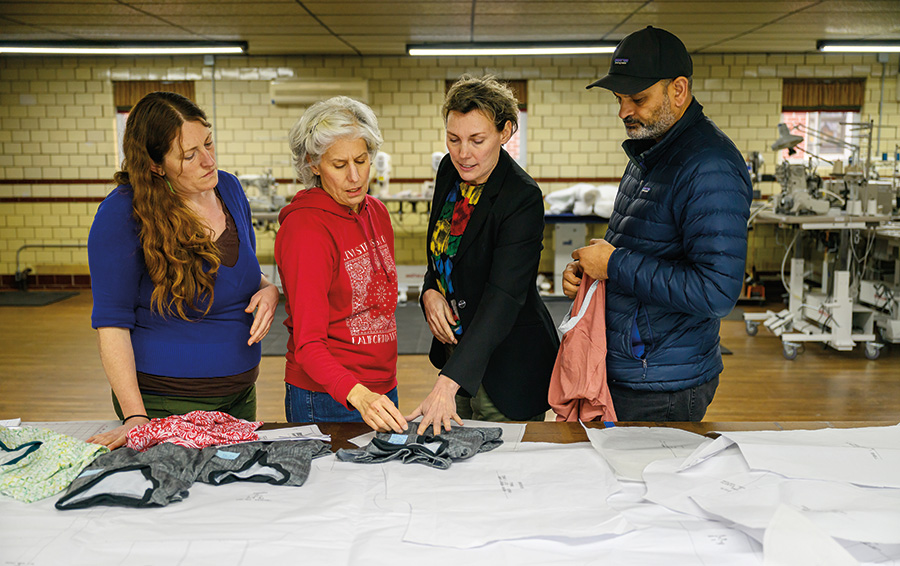
Founder Betsy Franjola (third from left) reviews garment patterns and sample pieces with collaborators. Photo by Ben Wirtz Siegel, BSVC ’02
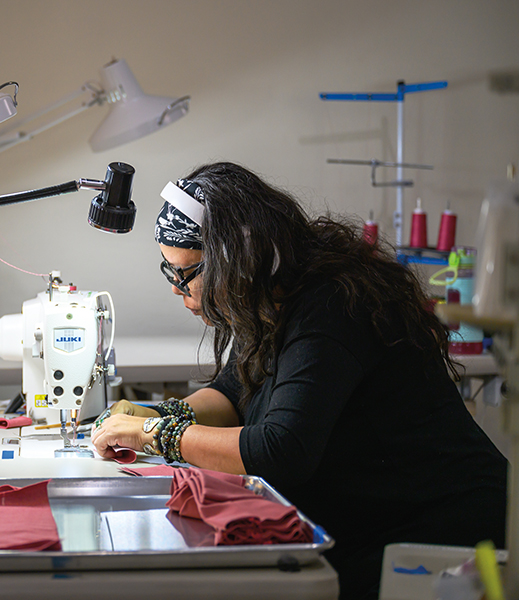
With guidance from the Voinovich School, the center has built partnerships and a business plan to sustain local manufacturing. Photo by Ben Wirtz Siegel, BSVC ’02
How the Voinovich School helped launch a rural manufacturing startup
Franjola connected with Impact Enterprise Team Director Nathaniel Berger, BFA ’05, MA ’16, early in her planning process. She was invited to participate in a group pitch meeting, which served as practice for entrepreneurs like herself who needed to refine their presentations. After the session, Berger reached out. He thought Franjola would be a good candidate for the school’s technical assistance services and explained how they could help.
What followed were regular calls and introductions. “He would introduce me to different people,” Franjola says. “He was trying to connect me with the right not-for-profit group for that partnership and to open that door.”
That door led to grant funding, an important opportunity for a for-profit social enterprise that Franjola largely funded herself. Berger sent Franjola across the region to various organizations, exploring potential partnerships. Eventually, she connected with the Survivor Advocacy Outreach Program (SAOP). Among other initiatives, SAOP works to provide economic assistance for survivors of sexual and domestic violence, including paid workforce development training.
“Once they found out what we were doing, and I understood what their mission was, it was just so perfectly aligned,” Franjola explains. SAOP applied for a federal Department of Labor grant that funded workforce development for three people. “That was that next catalyst of like, OK, now we have some funding, we can get going.”
When Franjola first heard about an old church for sale in Buchtel, her initial reaction was skepticism. But after virtual tours revealed two large open rooms, a parking lot, ADA-approved bathrooms, and a functional kitchen, she bought it sight unseen.
Workforce development that supports rural manufacturing growth
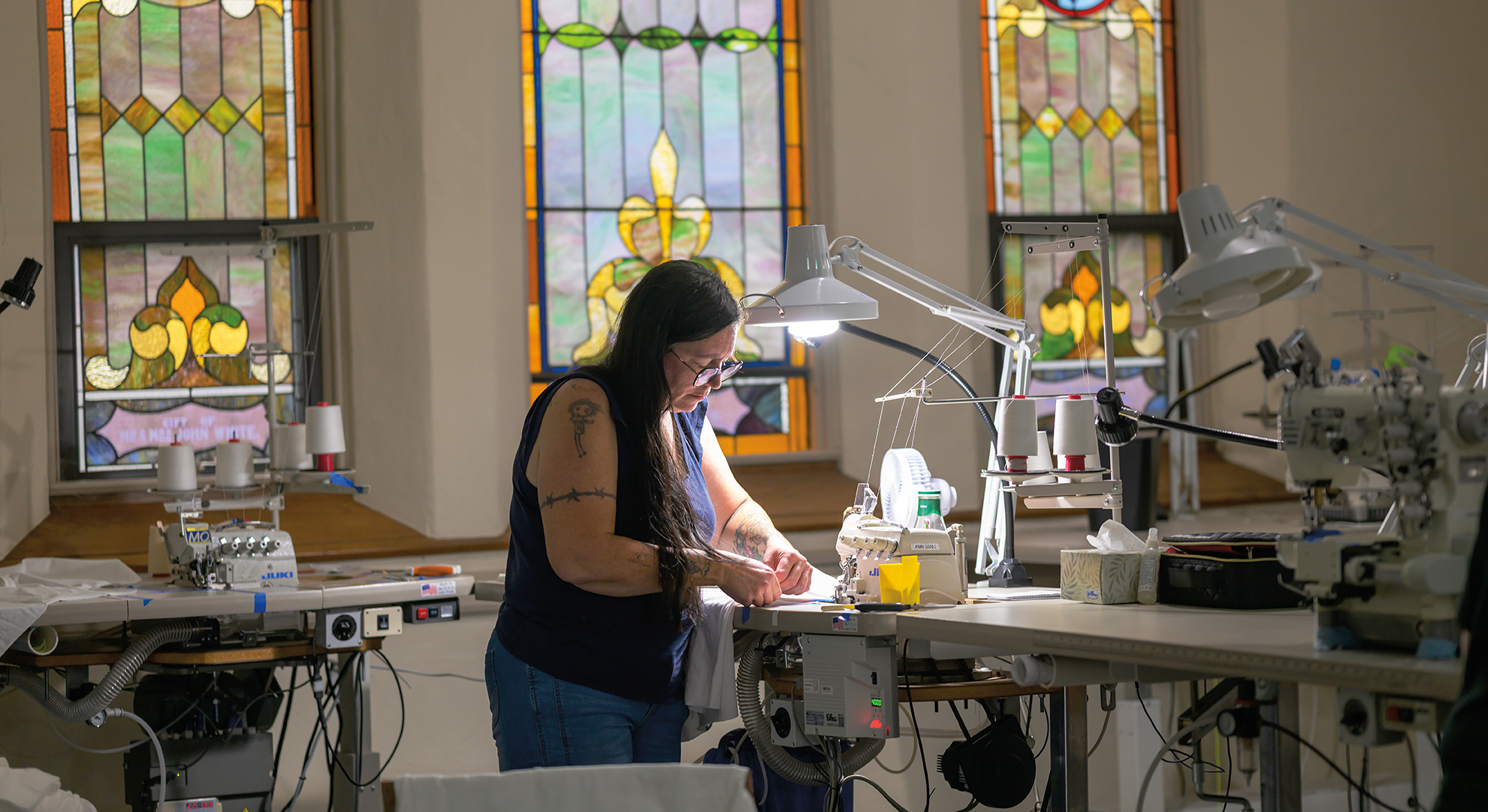
Inside the former church’s sanctuary, the transformation is striking. What once held pews now houses sewing cells, workstations where sewers learn industrial techniques. A small cutting table allows for runs of 100 pieces or fewer and sample work. Training happens in dedicated spaces, with plans to expand into the garage out back for fabric storage and shipping.
The building sits on a large lot, and Franjola dreams of adding on in the future, maybe even with space for an automatic cutting machine. “One of the challenges that we have is that we don’t have any industry partners in this region,” she explains. “Everything [that needs to be cut] has to either be done in LA and shipped to us” or cut in North Carolina and shipped north.
The center’s employees draw from diverse backgrounds: car seat manufacturers, home sewists, costume designers and complete beginners.
Erin Hogan, BSS ’10, a cell leader at the facility, exemplifies the center’s approach to workforce development. She learned to sew in Ohio University’s theater costume shop and now assists other sewists while developing samples.
“This is like sewing grad school,” Hogan says. Her role involves helping others learn about the products, improve speed and efficiency, and translate designers’ requests into manufacturable samples.

The sanctuary of the former Buchtel church before its transformation, with wooden pews and vaulted ceilings defining the space that once served as a place of worship. Photo by Ben Wirtz Siegel, BSVC ’02
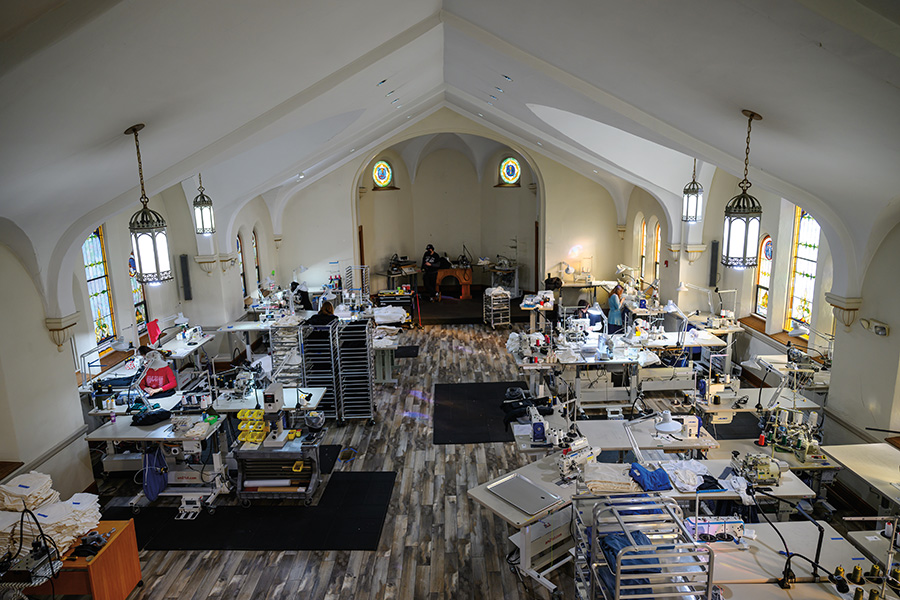
The same space reimagined as a manufacturing floor, now filled with industrial sewing machines, cutting tables, and training stations at the Hocking Hills Garment Center. Photo by Ben Wirtz Siegel, BSVC ’02
The nonprofit collaboration that jump started the Garment Center
The Voinovich School’s support extended far beyond introductions. Impact Enterprise Team members walked through cost sheets with Franjola to ensure her numbers made sense.
“I was an entrepreneur before, but I had never approached something at this scale,” she says. “So having that official plan, not just jumping into it organically, which is what I had done before, was really incredible.”
Another mentor provided templates for financial frameworks during that crucial first year, walking Franjola through projections, business plans, and vision statements. She leaned on Berger as a sounding board throughout the process.
The Voinovich School also connected her with student designers at OHIO to develop branding—“far beyond something I would have done on my own,” she notes. That support included community connections, marketing assistance, and strategic guidance on timing and pathways for growth.
The pressure and progress behind reviving local manufacturing
The journey hasn’t been without challenges, Franjola admits. The operation is almost entirely self-funded outside of workforce development grants.
Looking back two years to when Franjola first entered the space—machines still wrapped from shipping, the smell of old boiler water, no cutting tables—Franjola says she would tell herself, “‘Keep going!’ Because it really is overwhelming when you think about all that needs to be done.”
She also would have preferred to secure more funding up front, though she acknowledges the paradox: initial projections suggested she needed $3 million. “Had I hit pause and waited for that, the idea could have fizzled. Maybe it never would have happened. So just leaping in is why we are where we are today.”
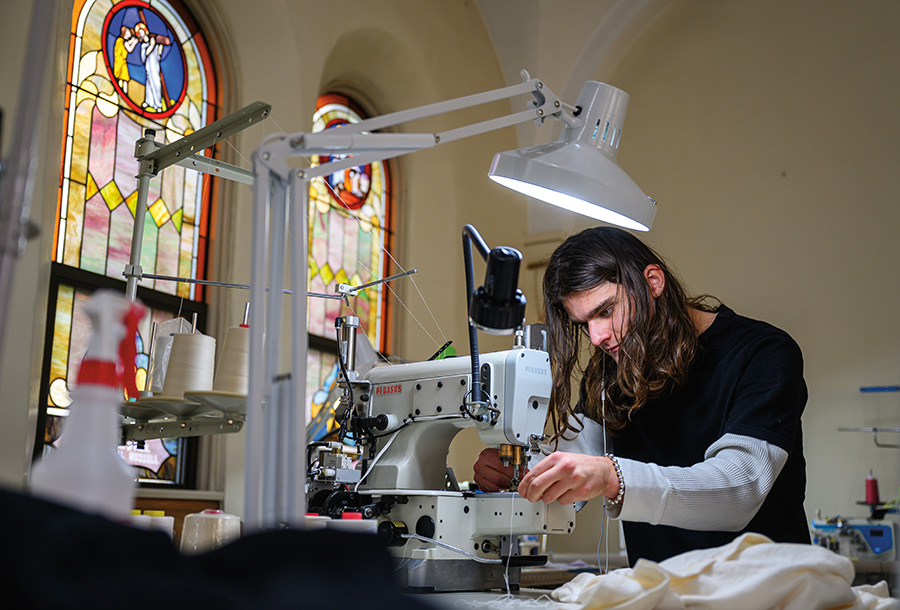
Garments move through the production process where cutting, sewing and training now fill a space once used for worship.
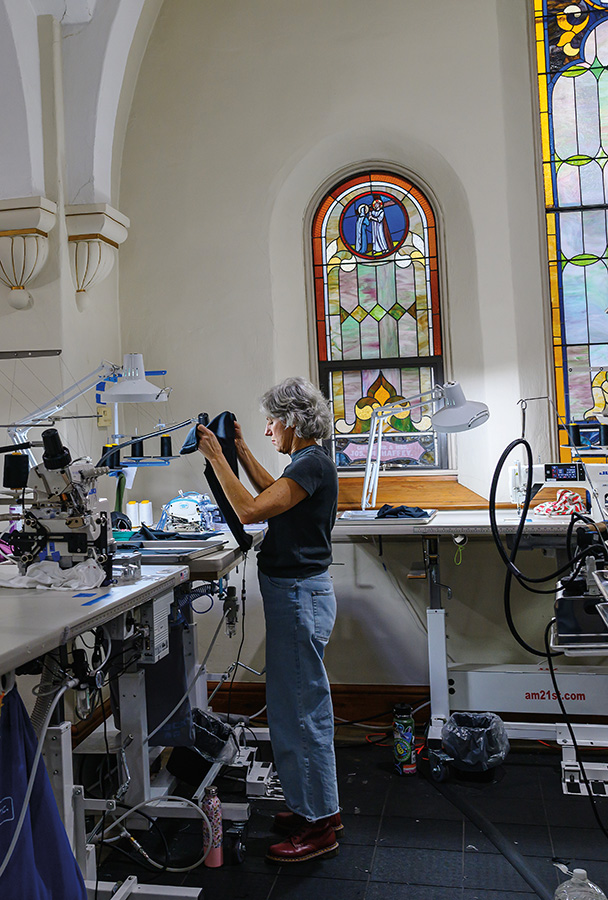
Photos by Ben Wirtz Siegel, BSVC ’02
What’s next for the Hocking Hills Garment Center
Despite the challenges, Franjola has connected with exciting collaborators and says the center is eager to connect with additional brands seeking domestic production partners. Among those collaborators are Future Plans Ohio and Erin Harper Films, who tell the center’s story through the documentary, “We Make Your Clothes.” The ability to share the message and find brand partners whose values align—sustainability, quality, skilled labor—creates momentum for the center’s next steps.
“Our long-term vision extends beyond HHGC,” Franjola states. “We’re working toward a regional ecosystem that connects fiber agriculture to textile production, from wool and natural dye crops grown by local farmers to regional dyeing, knitting and garment manufacturing.”
For others considering working with the Voinovich School, Franjola’s advice is simple. “I would highly recommend it,” she says. “The resources they provide, the local contacts—for me, I grew up here, so I had some folks that I knew, but really appropriate contacts and putting all those pieces together was really beneficial.”
For Franjola, it’s a connected story: growing up in Athens, working in the fashion industry across the country, then returning home to connect those worlds. “It really feels very full circle,” she says, “which is awesome.”