
Spring 2026 Edition
Alumni & Friends Magazine
Time Machine: A Half-Century of Health
The Heritage College of Osteopathic Medicine celebrates 50 years
April 28, 2026
Share:
Discussions of a medical school in Athens began in 1823, when the OHIO Board of Trustees formed a committee to study the possibility and set aside land for a future facility. More than 150 years later, that dream became reality in September 1976, when 24 students became the inaugural cohort of the state’s first osteopathic medical school; 21 comprised the first graduating class four years later. By 1982, what was then called the Ohio University College of Osteopathic Medicine was enrolling 100 students each year.
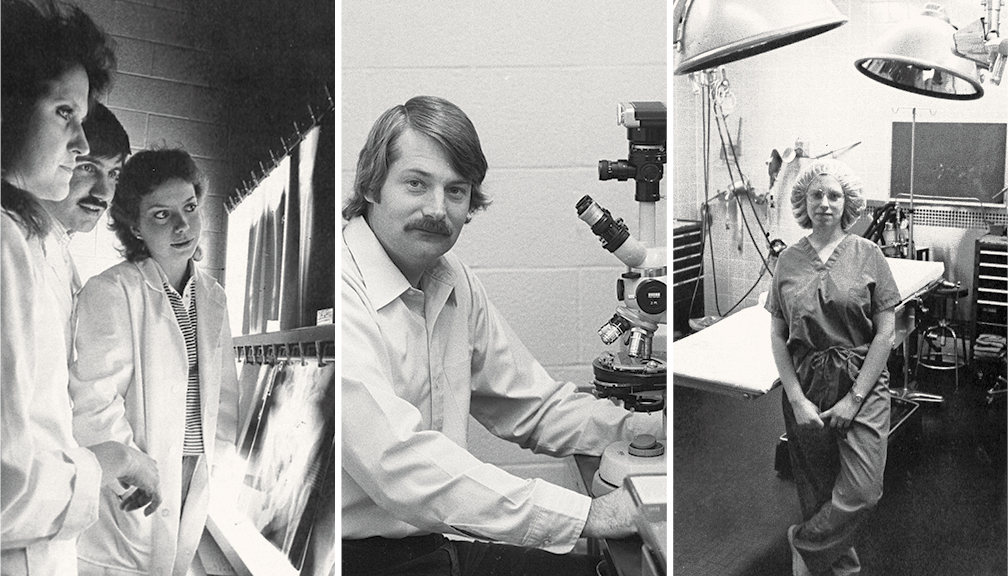
The college quickly established itself as a pioneer of medical research. In 1980, Professor Thomas Wagner led a team of researchers to develop DNA microinjection, transferring a gene from a rabbit and into a mouse, becoming the first researchers to create a transgenic mammal, and setting a foundation for countless future biomedical breakthroughs.
A focus on holistic care and an unwavering commitment to improving the health and well-being of Ohio communities became an early hallmark of the college as well. Today, the college continues to distinguish itself through its mission dedicated to groundbreaking research, exceptional patient care and top-tier medical education.
That mission received a boost in 2011, with a landmark $105 million funding award from the Osteopathic Heritage Foundation—then the largest gift ever made to a higher education institution in Ohio. Shortly after, Trustees approved a name change to what we now know as Heritage College of Osteopathic Medicine. The grant, Vision 2020: Leading the Transformation of Primary Care in Ohio, allowed for a massive expansion of the college’s primary care, medical education and research efforts.
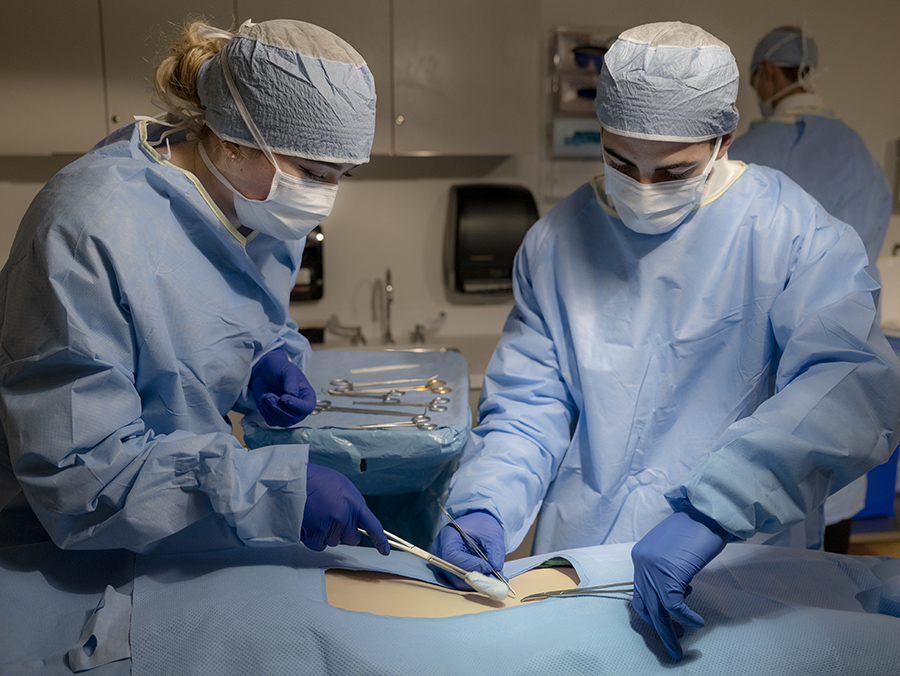
Photo by Rich-Joseph Facun, BSVC '01
In 2014, Heritage College opened its second campus in Dublin, Ohio, followed quickly in 2015 by a third campus in Cleveland. In 2021, Heritage Hall, a state-of-the-art medical education facility opened on the Athens campus, and construction on the college’s new research building, the Heritage Translational Research Center, is expected to wrap up in late 2026.
The Osteopathic Heritage Foundation’s support continues: Last year, it pledged an additional $70 million, bringing its total contribution to over $193 million. Over the next decade, new funds will support 100 annual scholarships and several new endowed faculty positions, along with a new research institute focused on healthy aging.
Fifty years after its opening, Heritage College has more than 1,000 students enrolled annually across its three campuses and is the state’s leading producer of primary care physicians. In 2025, U.S. News & World Report ranked the college 21st in the nation and No. 1 in Ohio for the number of its graduates who practice in rural areas. —Cat Hofacker, BSJ ’19
Featured Image: LEFT: Students study X-rays to prepare for a gross anatomy exam, 1984. Photo courtesy of Ohio Medicine magazine. CENTER: Professor Thomas Wagner, 1980. Photo courtesy of the Mahn Archives and special collections. RIGHT: Hinda Abramoff, the first D.O. graduate in the state, 1982. Photo courtesy of Ohio Medicine magazine.